I have some exciting news: I will be writing for Urban Gaming Elite! As a longtime gamer, I’m thrilled to have the opportunity to write about an industry that I love.
You can check out my first article here. It’s a preview of a promising RTS game called 0 A.D. If you liked Age of Empires, you’ll probably like 0 A.D. It’s being developed by a team of volunteers from all over the world, and it will be totally free to play when it finally launches. There’s no release date as of yet, but in the meantime, you can play with the alpha build. It’s definitely worth a look.
Some random thoughts that didn’t make it into my article:
I question the decision to use Middle Egyptian building names for the Ptolemaic faction. Admittedly, I’m not much of an expert on the Greco-Roman period because it’s boring, but my understanding is that Greek was the language of administration. And if you want to get really pedantic, you could argue that Demotic would be a better choice than Middle Egyptian since Middle Egyptian was only used in highly formal contexts by the Ptolemaic era.
The ships look awesome. It’s just a shame you can’t really do much with them at the moment since the AI doesn’t know how to use them yet.
I wish the game had more non-Mediterranean civilizations. It seems strange that the Seleucids, Ptolemies, and Macedonians each get their own faction, yet there isn’t a single faction from Eastern Asia (though India is represented by the Mauryans).
The game places some annoying restrictions on construction (e.g., you have to build towers a certain distance apart, and civic centers have to be placed a certain distance from resources). One of the great things about old-school RTS games like Age of Empires II is that the game lets you do whatever the hell you want. Want to build fifteen towers right next to each other? You can do that! Want to build a dozen castles? You can do that, too! The best games are the ones that give you the freedom to do silly things instead of holding your hand or trying to nudge you toward a certain course of action.
The skirmish maps suffer from Diablo III Syndrome (i.e., they look really pretty, but they get old after a while since there’s insufficient randomization). I hope the game will eventually have a fully random map mode. Hand-designed maps based on real-world geography are nice, but they reduce the replay value since you eventually come to know them like the back of your hand.
One of the people I follow on Twitter recently posted a link to an epic example of how an author shouldn’t behave. The writer in question, Stephan J. Harper (not to be confused with the Canadian Prime Minister!), wrote Venice Under Glass, a mystery set in La Serenissima that features teddy bears for protagonists. Michael Cohen over at Tidbits.com gave the book a middling review. Instead of grumbling to himself and moving on with his life, Harper had a meltdown in the comments section. He began by citing passages from the book that allegedly refuted Cohen’s criticisms, but when the other commenters basically told him to chill out, his responses devolved into ad hominem attacks.
What Harper doesn’t seem to understand is that writing a review is an inherently subjective exercise, and people will inevitably have different reactions to a given work. Although he keeps insisting that Cohen needs to support his arguments with quotes from the text, doing so would be pointless. When Cohen says that Harper’s prose is ‘workmanlike,’ that’s his opinion. It can’t be proven or disproven because it’s ultimately a question of taste, and as they say in Latin, de gustibus non est disputandum. I may think Firefly is one of the most overrated shows in the history of television, but that doesn’t mean that the legions of Firefly fans are in the wrong.
Harper might want to take a page from Colin Morgan’s book. An interviewer once asked him if he read what the critics were saying about his work, and he said no. He thought that positive reviews would give him a swelled head, while negative reviews would just bring him down. Those are wise words for creative-types.
Age of Empires II: The Age of Kings was a huge part of my adolescence. It was one of the first games that I actively looked forward to, and I was so excited when it finally came out. The coolest thing about it was that I could play as the Byzantines. I was really interested in the Byzantine Empire in high school (I used to read Donald Nicol’s Byzantium and Venice and Warren Treadgold’s History of the Byzantine State and Societyduring study hall), and I would spend hours skirmishing against the Turks with my hordes of cataphracts. I wasn’t a very good player though–I was more focused on historical accuracy than playing a good game. I was obsessed with deploying my units in historically accurate ratios, regardless of what was actually needed to counter my opponents, and I refused to use units that the Byzantines didn’t use in real life (e.g., camels and hand cannoneers). Although I eventually moved on to other games, I always had a soft spot for AoE 2. When I saw that Microsoft had released an HD version of the game through Steam, I knew I had to buy it.
I purchased the deluxe edition, so in addition to a remastered version of the original game and The Conquerors expansion pack, I also got The Forgotten, a new expansion pack that started out as a fan-made mod. Although my inner cheapskate caviled at the idea of paying for a game I already owned, I’m really glad I bought it. The graphical changes in the HD edition are nice (the most noticeable change is that water now ripples with waves instead of looking like a painting), but the new civilizations are where the game really shines. I’m particularly glad that the Italians have finally made it into AoE 2. As a teen, I was frustrated by their absence from the original game since I wanted to recreate things like the Byzantine-Venetian War. I usually ended up playing as the Goths and pretending to be Venice, but that wasn’t very satisfying (huskarls aren’t terribly Venetian!).
The mighty Byzantine army. I’ve added a mod that changes the unit graphics, so they look a bit different than those found in the original game.
I haven’t played all five of the new civs yet, only the Italians and the Slavs. Those two are quite interesting to play, though. The Italians actually have two unique units, the Genoese Crossbowman (archer with an attack bonus vs. cavalry) and the Condottiero (infantry with an attack bonus against gunpowder units), and their cheaper maritime technologies gives them a boost on water maps (though it would have been nice if the ships themselves received a boost). The Slavs have great infantry (one of their unique technologies, Druzhina, gives them trample damage like the Byzantines’ cataphracts), and their unique unit, the Boyar, is a horseman who can tank. They also get cheaper siege units, which can be a huge advantage (after watching Resonance22’s YouTube channel, I’ve learned to appreciate the power of massed onagers!).
The computer’s AI has also been improved. It’s still not as skillful as a human player, obviously, but it can give you an interesting game. My big complaint is that it doesn’t seem to be good at varying its strategies based on the strengths of the civilization it’s playing. No matter which civ it is, the AI likes to build lots of light cavalry and pikemen. That being said, it does tend to build lots of paladins when playing as the Franks and lots of monks when playing as the Slavs (few things are more frustrating than running into a wall of 15-20 monks chanting away, particularly if you haven’t researched Faith yet!), but that seems to be the extent of its civ-specific strategies. Unfortunately, the units’ AI is still pretty stupid. Villagers will frequently stand around doing nothing as if they’re stoned, and your military units seem to have a death wish (the latter can be overcome to some extent by setting their attitude to “stand ground,” but this can turn them into strict pacifists who won’t intervene if one of their brethren is being attacked). Don’t even get me started on the pathfinding…
What I really love about AoE 2 though is the old-school economic management. Modern RTS games tend to dumb-down simplify the economic aspect of the game in order to focus on combat. Maybe I’m weird, but I like the challenge of building a diverse economy and keeping it balanced. At the beginning of the game, you’re often chronically short of resources as you build your empire, so it’s rewarding when you finally reach the point where you can build whatever you want.
I also love the degree of freedom that AoE 2 gives you. Newer games seem to like placing restrictions on the player. In Age of Empires III, for example, certain buildings can only be built in limited numbers, and that kind of irks me. If I want to build more than one church or a gazillion houses, I should be able to. I don’t want to be trammeled or have my hand held by the designers; I want the freedom to do crazy things, like attack with mass monks.
All in all, I highly recommend AoE 2 HD. The base game has held up very well. The graphics are still appealing, and they don’t look as dated as those found in early 3-D RTS games such as Empire Earth. There are, however, a few niggling quality-of-life issues. There’s no automated scouting button, so you’ll have to maneuver your scout around the map by hand, and the system for replenishing your farms is kind of clunky. But these are really just trifles, and they’re not annoying enough to tarnish the overall gameplay experience. It’s a first-class game, and I’m glad that it’s been made available for a new generation of gamers to enjoy.
I’ve discovered that Hollywood is planning to make an epic fantasy movie set in ancient Egypt. Entitled Gods of Egypt, it will star some big names, including Nikolaj Coster-Wald, Gerard Butler, and Geoffrey Rush. At first, I was cautiously excited; naturally, the idea of an epic fantasy movie set in Egypt should be right up my alley. But when I read the synopsis on IMDB, my heart sank: “Set, the merciless god of darkness, has taken over the throne of Egypt and plunged the once peaceful and prosperous empire into chaos and conflict.”
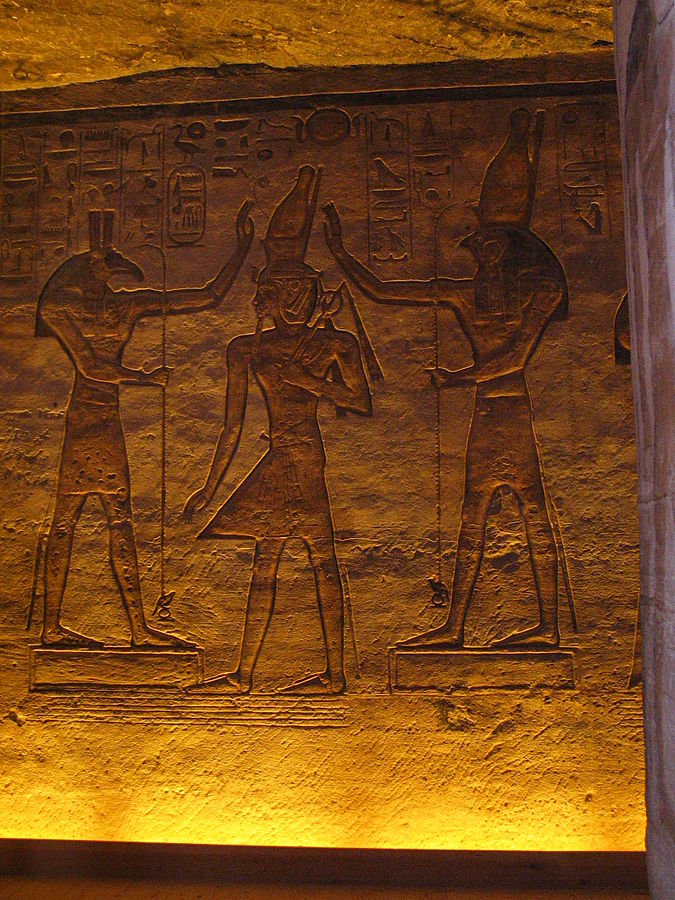
“SethAndHorusAdoringRamsses” by Chipdawes – public domain via Wikimedia Commons.
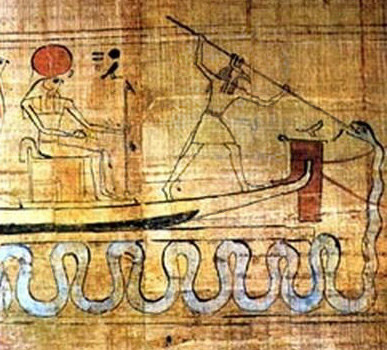
From an Egyptological perspective, characterizing Set as an evil god is highly problematic. Although he’s often referred to as a ‘god of chaos,’ that’s a modern gloss on his character. It’s true that he was demonized in the Late Period, but in earlier times he was a much more ambivalent figure. For much of Egyptian history, his cult flourished in the Delta region and at Ombos. Several pharaohs were named after him, such as Seti I, whose name literally means ‘man of Set’ (ordinary people also incorporated Set’s name into their own as well). There are also a number of depictions of Set crowning the king alongside Horus (the one on the right is taken from Ramesses II’s small temple at Abu Simbel). Set also had a reputation for martial prowess, which is why he is often shown at the forefront of Re’s solar barque, spearing the evil snake-creature Apep.
However, he definitely had a darker side. As early as the Pyramid Texts, he was described as the murderer of his brother Osiris, and there are references to him fighting Horus (who can be either his brother or his nephew, depending on the text!) for the throne of Egypt. An extended narrative of Set’s struggle with Horus for the throne of Egypt can be found in the Contendings of Horus and Set, which was written in the New Kingdom. There, Set is portrayed as a violent buffoon who is easily tricked by Horus into building a boat out of stone. When the gods finally decide to award the throne to Horus, Set is compensated by being given dominion over the desert. He still retained Re’s favor, as well.
Set defending Re from Apep by An unknown workman – Egyptian Museum, Cairo. Public domain via Wikimedia Commons.
Set didn’t become a totally evil figure until the Late Period, at which point he replaced Apep as the embodiment of evil. It’s not entirely clear why he fell from grace, but Herman te Velde has suggested that his demonization was due to Egypt’s conquest by outsiders such as the Assyrians and the Persians. Set was historically seen as the patron of foreigners, and their subjugation of Egypt might have made Set’s cult less attractive.[note]H. te Velde, Seth: God of Confusion (Leiden: E. J. Brill, 1967), 138-140.[/note]
Unfortunately, it’s the negative characterization of Set that seems to prevail in popular culture today. Writers often cast him as the Egyptian version of the Christian Devil, despite the anachronistic nature of such an approach. Rick Riordan is one of the few authors who has demonstrated an awareness of Set’s nuanced nature.
The fact that the team behind Gods of Egypt has chosen such a hackneyed and inaccurate approach makes me doubt the quality of the rest of their research. I fear their depiction of Egypt will be little more than a bunch of people with tea towels on their heads running around a set that’s festooned with a random assemblage of Egyptianesque artifacts. Oh, and apparently most of them will be white for some unfathomable reason (perhaps the casting directors are disciples of Sir Flinders Petrie!).
The BBC has run an article by Jane Ciabattari that examines the relationship between George R. R. Martin’s Game of Thrones saga and the works of J. R. R. Tolkein. It’s a decent read, though I took issue with several paragraphs toward the end:
By definition, fantasy should be a limitless genre of unbounded imagination. Isn’t it time we came up with something new?
There are two reasons for this. To start with, it’s about sequels. In the age of algorithm-assisted online shopping and ‘if you like that, you’ll like this’ recommendations, the gatekeepers at the biggest publishing companies tend to choose the tried-and-true over the quirky or original. The five novels in Martin’s series to date have topped bestseller lists and sold more than 15 million copies in all.
And secondly, the familiar prevails. Readers often gravitate toward the childhood obsessions they love, which include games like Dungeons and Dragons and books involving swordplay and witchery. And the swords-and-dragons tale works in any century, because of commonalities across Western history.
It’s a shame that Ciabattari failed to acknowledge that there are a number of contemporary fantasy authors who avoid the stereotypical medieval setting. For example:
Aliette de Bodard’s Obsidian and Blood trilogy is set in the Aztec Empire;
Saladin Ahmed’s Throne of the Crescent Moon is set in a world that’s inspired by the medieval Middle East;
N. K. Jemisin’s Inheritance Trilogy and the Dreamblood series are both set in unique universes that are influenced by a wide range of cultures;
Susanna Clarke’s Jonathan Strange & Mr. Norrell is set in 19th century England.
These books might not be mega-bestsellers like GoT or LoTR, but that doesn’t mean they’re obscure. They were all published by big-name publishers, and many of them won prestigious awards. The genre isn’t quite as homogenous as Ciabattari seems to believe, and it’s unfortunate that she chose to resort to sweeping generalizations.
As many of you know, I’m something of a Westminster nerd, and I spend a lot of time blah-blah-blahing about the British constitution. Until now, I’ve been content to post that stuff here along with my thoughts on Egyptology, video games, writing, etc., but from now on, it will appear on a separate blog entitled A Venerable Puzzle.
Now you may be asking yourselves, “why the hell is Jason creating a separate blog when he can barely be bothered to update this one in a timely fashion?” The answer is that I want to make this place less of a gallimaufry, and of all the things I like to pontificate about, the British constitution seemed the best candidate for a spin-off.
I just learned that John Baines retired at the end of last year. Baines was Professor of Egyptology at The Queen’s College, Oxford, and he’s something of a living legend in the Egyptological community. A professor by 30, he went on to have a distinguished scholarly career, as his list of publications vividly demonstrates.
Baines’ work has been invaluable to me over the years. He co-authored The Cultural Atlas of Ancient Egypt, which was one of the first scholarly books about Egypt that I ever owned. Although it’s outdated in places, it still provides a solid overview of Egyptian civilization, and it’s a must have for any Egyptophile (though, sadly, it seems to be out of print). Baines has also made a major contribution to the study of literacy in ancient Egypt, and his 1983 article on the subject is still widely cited. His most recent book is about elite culture, and I plan to read it in the near future.
Baines is also a really nice guy. Many years ago, I emailed him with some questions about Egypt. I was so young that I didn’t have my own email address, and I had to send it using my mom’s account (and I think I’ve just dated myself!). I can only vaguely remember the questions; I believe I asked him something about priestly celibacy and Egypt in the Greco-Roman period. But he wrote back with detailed, helpful answers, and I’ve always appreciated his willingness to answer questions from a random American kid.
The Egyptians would have called Baines “a good scribe and an exceedingly wise man,” and his successor will have some big shoes to fill. I hope he has a long and happy retirement, and with any luck, we’ll be reading his work for many years to come.
If you’re a child of the 80s, you probably remember the Scary Stories trilogy by Alvin Schwartz. The stories themselves were fairly tame, and it was Stephen Gammell’s illustrations that really made the books memorable. When I was a third grader, those nightmarish landscapes and grotesque figures were absolutely terrifying (the illustrations for “The Haunted House,” “The Dream,” and “Someone Fell from Aloft” were particularly spooky), and they’re still pretty damn unsettling 20 years later.
To celebrate the 30th anniversary of the publication of the first Scary Stories book, HarperCollins commissioned new artwork by Brett Helquist. The result is…underwhelming to say the least. Helquist is a fine artist, but his work lacks the distinctive horror of Gammell’s. Adventures in Poor Taste has a nice piece that compares and contrasts the two sets of illustrations, so you can see for yourselves just how different they are.
I have no idea why HarperCollins decided to tamper with something so iconic. The cynic in me wonders if it isn’t a deliberate attempt to sanitize the books (they were, after all, frequently challenged by outraged parents who wanted to keep them out of school libraries). Helquist’s work is safe and anodyne, and I doubt it will stick in people’s minds like Gammell’s did.
I’m glad I kept my copies of the original editions!
In some quarters, yesterday was considered the feast of King Charles the Martyr, better known to most people as Charles I of England, Scotland, and Ireland.
Charles probably had one of the unhappiest reigns of any English monarch. A strong believer in the Divine Right of Kings, he was almost constantly at loggerheads with Parliament, and he sought to rule as an absolute monarch. The final straw was when he tried to force Anglicanism on Scotland, resulting in the Bishops’ Wars, which served as a prelude to the English Civil Wars of 1642 to 1651.
After Sir Anthony van Dyck [Public domain], via Wikimedia CommonsAs many of you know, Charles was ultimately defeated, put on trial, and executed. But of course the monarchy was eventually restored, and in 1660, the Convocations of Canterbury and York decided that the day of Charles’ execution should be commemorated with a special service in the Book of Common Prayer. The service was subsequently annexed to the Prayer Book by a royal warrant of Charles II along with the services commemorating the Gunpowder Plot and the restoration of the monarchy.[note]Legally speaking, they were an addendum to the Prayer Book since they were not included in the text that was attached to the Act of Uniformity 1662.[/note]
The service itself was a piece of ecclesiastical masochism filled to the brim with handwringing over the evils of executing a divinely anointed sovereign. By the mid-nineteenth century, this attitude seemed increasingly out-of-date, and Queen Victoria removed it from the Prayer Book in 1859 at the request of both Houses of Parliament along with the Gunpowder Plot and Restoration services.[note]Some Anglo-Catholics question the validity of Victoria’s warrant discontinuing these services, but since the services were enjoined by royal fiat rather than statute, they could be removed by an executive act of the sovereign alone.[/note]
Nowadays, the cult of King Charles the Martyr has largely faded from public view, though he still appears in the Calendar of Common Worship, the book of ‘alternative’ services that has replaced the Book of Common Prayer in many Church of England parishes. Although some Anglo-Catholics bewail the downgrading, the cult of King Charles the Martyr is an aberration best left in the seventeenth century.
One of the justifications for his continued commemoration is that he was a martyr for Anglicanism. Anglo-Catholics often paint him as a stalwart defender of episcopacy and Catholic tradition in the face of militant Presbyterianism.[note]In reality, Charles was a pragmatist who was willing to throw the episcopate under the bus if he thought it would help his cause. For example, after he was captured by Parliamentary forces in 1647, Charles signed a secret treaty with the Scots (known as ‘The Engagement’) wherein he promised to impose Presbyterianism on England for three years in exchange for military support.[/note] Now I have no problem with episcopacy (I am, after all, an Episcopalian!) or Catholic tradition, but I’m not sure they’re more important than the liberties of Charles’ subjects. This was a man who had no problem imprisoning people without trial and imposing illegal taxes, and his behavior was seen as problematic even by seventeenth-century standards.
I’ve heard defenders of Charles try to get around his failings by pointing out that nobody’s perfect, and just because a person has flaws doesn’t mean they aren’t worthy of veneration by the faithful. But by the same token, just because someone displays certain virtues doesn’t mean they should be venerated either. It’s ultimately a question of balance, and in the final analysis, Charles seems rather wanting.
The list of pharaohs has just gotten a bit longer. The University of Pennsylvania has uncovered the tomb of a pharaoh named Woseribre Senebkay, who apparently ruled as part of a previously unknown dynasty based out of Abydos. This news has made it into the mainstream media, but I highly recommend reading the official Penn Museum announcement. A lot of the mainstream coverage has been sort of silly (such as this gem from the Daily Pennsylvanian: “Most tombs have unadorned walls, stripped of their decorations by ancient plunderers”.[note]Tomb walls were decorated with frescoes and carvings. Not exactly something a tomb robber would make off with![/note]).
As is so often the case, the tomb was plundered in antiquity, so there isn’t a lot of bling left. Poor Senebkay even suffered the indignity of having his mummy torn apart by grave robbers. Judging from the remains of his canopic chest (which had the name of a previous royal owner covered over with gilding!), it seems that his burial may have featured a lot of ‘recycled’ material.
Senebkay reigned c. 1650 BCE during a time scholars call Second Intermediate Period. The SIP was a time of political fragmentation and disorder, and we don’t really have a firm grasp of the chronology. Until now, Senebkay was pretty much unknown to history, though the Turin King List contains two fragmentary references to kings with similar throne names.
The Turin King List. Image courtesy of Wikimedia Commons.
Although Senebkay styled himself ‘King of Upper and Lower Egypt’ in his tomb, he was probably little more than a local potentate whose domain was limited to Abydos and its environs. In his time, the Delta was under the control of foreign kings who belonged to a group called the Hyksos (a word that’s derived from the Egyptian Ḥq3-ḫ3st, or ‘Rulers of Foreign Lands’), while Thebes was ruled by a dynasty that would eventually expel the Hyksos and reunify Egypt. The presence of reused material suggests that he might have been comparatively poor, though it’s also possible that he simply died before he had time to acquire his own funerary equipment.
This discovery just goes to show that, despite all the advances that Egyptology has made over the past 200 years, there are still gaping lacunae in our understanding of Egyptian history.



 Codex Lochianus