A historical hatchet job

While browsing the stacks of Memorial Library the other day, I came across a copy of Toby Wilkinson’s The Rise and Fall of Ancient Egypt. To be honest, I’d been avoiding it for some time. When it was published, Wilkinson made it very clear that he wrote the book with an agenda in mind. He believes that scholars and the general public tend to view pharaonic culture with “misty-eyed reverence,” and his book is an attempt to shatter their rose-tinted spectacles. Despite my misgivings, I had a sense of morbid curiosity about the book. So when I saw it on the shelves, I decided to take a gander at it and see if my fears were grounded in reality.

I decided to start out by seeing what he had to say about the end of the 20th dynasty, which is the period I write about in my fiction. Not surprisingly, his account focuses on the travails of Amenhotep and Panhesy (which form the backdrop of The World Inverted) since that’s the best-documented episode from an otherwise shadowy era. And when I say that it’s the “best-documented episode,” I mean we have a handful of random documents that refer to it in varying levels of detail. But we still know next to nothing about it, and scholars still debate the basic sequence of events.

You would never guess that from Wilkinson’s book, however. He presents a clear narrative that begins when a group of “hungry, desperate, and frustrated” Thebans remove Amenhotep from the high priesthood of Amun because of his “intransigence.” Amenhotep reluctantly appeals to Ramesses XI for help (“[g]roveling to the pharaoh was an unwelcome prospect for Amenhotep, but he knew it was the only path back to power”), and the king dispatches Panhesy, the Viceroy of Kush, to restore the ousted prelate.

But when Panhesy arrives, he brings “the roughness of military justice” with him, complete with summary executions. He also takes control of the royal granaries, which leads Ramesses to grow concerned since he can “sense Thebes and the south slipping away.” He dispatches General Piankh to dislodge Panhesy, but Piankh ends up ravaging Thebes in the requisite “orgy of destruction.”

Piankh’s rule in Thebes is characterized as a “military junta” that rules “with a rod of iron,” and of course Wilkinson quotes Piankh’s famous letter to his wife where he asks her to kill two policemen and throw their bodies into the river.  When Piankh dies, his ‘junta’ chooses Herihor (“a mature and capable leader in [Piankh’s] mold”), and Piankh’s widow swiftly marries him in a “brilliantly calculated move” that allows her to retain power.

It’s all very gripping, but Wilkinson has fleshed out the bare facts with a healthy amount of conjecture. We have no idea why Amenhotep was removed from office. We also don’t know Panhesy’s exact role in the affair. Far from being Amenhotep’s savior, he was probably the one to drive him from office (a statement made a few years later records that a certain event occurred “when Panhesy came and suppressed my superior (Amenhotep) though there was no fault in him.”). There’s also no evidence that Panhesy appropriated royal granaries. As Aidan Dodson points out in Afterglow of Empire, the evidence suggests that Panhesy eventually returned to favor, so there’s no reason to assume that his association with the royal granaries indicates anything untoward.

Similarly, we know very little about Piankh. Characterizing him as “an army man through and through, brusque, determined, and ruthlessly efficient” is a bit of a stretch given the lack of any firsthand accounts of his character. While there is some evidence that there may have been some sort of skulduggery going on (including the Nodjmet letter mentioned above), it’s almost impossible for us to draw firm conclusion. We have no idea why he wanted the policemen dead—there’s certainly no evidence that they were “mutter[ing] against the junta!”

All this would be fine if Wilkinson were writing historical fiction. But he isn’t; he’s writing something that purports to be history. I realize that he’s writing for a popular audience and therefore comes under more pressure to liven things up, but I think he should have made it clear where the facts end and his conjecture begins. In the endnotes that accompanied the bit I read, he simply mentions that the end of the 20th dynasty is a “hotly debated topic” and alludes to the disagreements over whether Herihor succeeded Piankh or vice versa.

Thankfully, there’s an alternative if you’re interested in the darker side of pharaonic civilization. Pascal Vernus’s Affairs and Scandals in Ancient Egypt is more limited in scope (he focuses on the end of the New Kingdom), but it does a nice job of examining societal turbulence without resorting to sensationalism.
Christmas comes early!

After years of searching, I’m finally the proud owner of Alexandre Piankoff’s The Tomb of Ramesses VI. Ramesses VI had one of the best-decorated tombs in the Valley of the Kings, and its walls were decorated with an unusually complete selection of Netherworld books. The Bollingen Foundation sponsored a photographic survey of the tomb and commissioned Piankoff to translate the texts into English. Although it was published over 50 years ago and probably went out of print shortly thereafter, Piankoff’s work is still useful because it contains the only English translations of many of these texts.

Unfortunately, second-hand copies of The Tomb of Ramesses VI tend to be quite expensive. The two-volume set usually sells for anywhere from $200-500. But in a stroke of staggering good fortune, I was able to get both volumes for $21 from a seller called Better World Books. Not only did I get a great deal, but they also donate a portion of their proceeds to various literacy-related charities.

As I waited for the books to arrive, I worried that the deal was too good to be true. Happily, my fears proved to be groundless. Both volumes are in excellent condition, and I’m thrilled with my purchase. If you’re looking for used books, you should definitely check them out.

Truth in fiction

I was rudely awakened this morning by the fire alarm.  As I waited outside for the all clear to return to my cozy bed, I decided to download a sample of Wilbur Smith’s Warlock on my iPhone.   Warlock is a fantasy novel set in ancient Egypt and I had been meaning to check it out for some time, but I never managed to get around to it until now.

By the end of the first page, it became apparent that artistic license was going to be the order of the day.   I had hoped that Warlock would be a work of historical fantasy on par with Susanna Clarke’s Jonathan Strange & Mr. Norrell, but Smith took so many liberties with the past that it had a negative impact on my ability to enjoy the story.

Now I get the fact that this is a novel and not a history textbook.  I also understand that artistic license is often necessary.  But if you’re going to set your work in a real-world society, I think you have to adhere to a certain basic standard of authenticity.  Populating your version of ancient Egypt with people named “Lostris” and “Memnon” is like writing a story about feudal Japan with characters named “Tiffany” and “Bartholomew.”  If you’re going to fudge that many details, why not just go all the way and set your story in a wholly fictional world of your own creation?

Let me make one thing clear, though: I’m not saying that Warlock is a bad book because it lacks authenticity.  It’s just not the sort of book I want to read.   I think I’ll download something by C. J. Sansom instead…

Egyptian expeditions to Chad

This is cool:

http://www.unreportedheritagenews.com/2011/03/ancient-egyptians-made-arduous-trek-to.html

I have to admire someone who could leave the relative comfort of the Nile Valley and go off trekking through the desert.  That takes a lot more guts than I have!

The idea of a correlation between the geography of Chad and the geography of the Underworld as described in the Amduat is intriguing.  I’ve often thought that the distances mentioned were peculiarly specific and this could well explain that.

Tales of Ancient Egypt

I visited my mom over Easter and, while I was there, I had the chance to look through some of my old books.   One of the titles I came across was Tales of Ancient Egypt by Roger Lancelyn Green.  A friend of C. S. Lewis and J. R. R. Tolkein, Green was a great popularizer of world mythology and folktales. Tales of Ancient Egypt was my first exposure to ancient Egyptian literature and his retelling of the Setna Khaemwaset stories captivated me.  The sense of wonder that that little volume evoked has remained with me through the years and I owe Green an enormous debt of gratitude since his work set me on the path that would eventually lead me to Evil in Thebes.

Since I first read Tales of Ancient Egypt, I’ve read more Egyptian literature than any sane person should.  I can now see how Green took liberties with his source material.  Sometimes he bowdlerized, sometimes he simplified.  Every once and a while, he embellished for dramatic effect.  But because he was aiming to capture the spirit of his source material rather than the precise details, his renderings are often much more pleasing to the casual reader than the scholarly treatments found in Lichtheim or Simpson.

So if you’re looking for an accessible introduction to the world of Egyptian literature but don’t want to get bogged down in a sea of philological footnotes and opaque scholarly commentary (though I can’t imagine why anyone wouldn’t enjoy those things!), I highly recommend Green’s book.


Magically impotent pharaohs

Given the omnipresence of magic in ancient Egyptian society, it should come as little surprise that feats of magic are commonplace in Egyptian literature.  Their stories are filled with wise lector priests who can reattach severed heads, part the Nile, or send animated wax figures into Nubia to beat up a local chieftain.  But there is one person in Egyptian literature who never seems to work magic: the pharaoh.  In fact, in a number of stories the king is actually rescued from death or humiliation by the skills of a crafty lector priest.  This strikes me as odd.

Many of you have probably heard that Egyptian pharaohs were considered living gods.  But while Egyptian texts are quite clear that the king becomes fully divine after death, the nature of his divinity while alive is much harder to pin down.  The waters are muddied even further by the fact that kings such as Amenhotep III and Ramesses II seem to have been deified within their own lifetime and are in fact depicted making offerings to themselves.

Even if the Egyptians believed that their kings’ earthly divinity was strictly limited, that still doesn’t explain why he’s depicted as magically powerless in literature.  Lector priests aren’t in any way divine, yet they’re capable of working great feats of magic so it’s hard to see why the king couldn’t do so as well, even if his divinity doesn’t really manifest itself until after he’s dead.

It could be that this is all an accident of preservation.  After all, the existing corpus of Egyptian literature is doubtlessly just the tiniest fraction of what was originally produced.  Unfortunately, this fragmentation also makes it difficult for us to draw meaningful conclusions.  *Sigh*  On the plus side, it does mean that, as a writer, I have a lot of leeway when it comes to making up my own explanation. 😀

Scandal in ancient Egypt

I was reading a review today of Toby Wilkinson’s new book The Rise and Fall of Ancient Egypt where the reviewer mentioned “the failure of Egyptian writers to indulge in the kind of salacious detail that the Greeks and the Romans so relished.”  While it is undoubtedly true that we have yet to find an Egyptian Suetonius or Tacitus, we can’t say that that such a person never existed.

Unfortunately, the written source material for ancient Egypt is fragmentary at best and the best preserved texts are those carved on monuments.  As a result, we tend to have a lot of bland, official pronouncements about the glories of the king.  But that doesn’t mean that more irreverent works didn’t exist; it just means that they’re less likely to have survived since they would’ve been written on papyrus.

We already have some tantalizing hints of scurrilous stories.  Papyrus Westcar makes Khufu look like a jerk, while the tale of Pepy and General Sasenet suggests that the two of them were lovers.  Demotic literature is even more irreverent: Thutmose III has his rear end whipped by magical figures sent from Nubia and Amasis is portrayed as a drunk.  The tradition of writing down scandalous things about one’s superiors is probably as old as writing itself and I don’t think we should assume that the Egyptians were any more reticent about these things than anybody else.

As for Wilkinson’s book, I look forward to reading it, if only because I’m curious to see how he backs up some of his assertions.  In particular, I wonder how he supports his claim that there was “close surveillance” of the populace in pharaonic Egypt.  He’s a good scholar, so I’m sure it’ll be an interesting read.

The limits of Egyptology

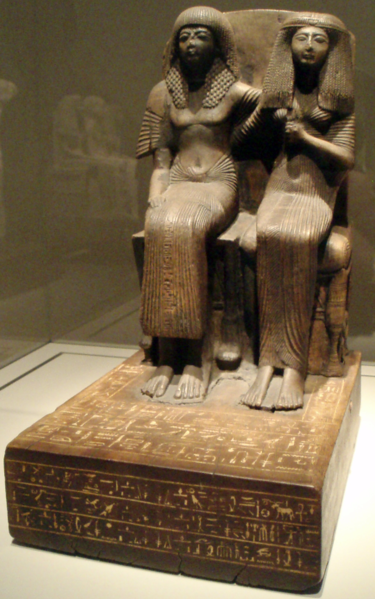
I came across this picture of a statue of Amenope and his wife Hathor this evening.

It’s a fairly typical New Kingdom statue of an aristocratic couple, but it made me think about the limits of the archaeological record.

As I looked at them sitting next to each other in a polite display of conjugal affection, I found myself starting to wonder what Amenope and his wife were like in real life.  Was he a bore?  Was she a nag?  Did they comfort each other through life’s innumerable storms, or did they quietly grow apart?  Were they happy with their lives, or did they want something more?

Egyptology has taught us a great many things about the ancient Egyptians.  But, alas, some things will always remain lost in  the past.