I’m embarrassed proud to announce that I’m now on Twitter. You can follow me at JasonLoch where you’ll get 46% more harping about the importance of historical accuracy and 65% more soporific commentary on the writing process. All in 140 characters or less! It’s a deal you won’t want to miss!
Author: jasonloch
The list keeps on growing…
I’ve crossed one book off my summer reading list only to add three more:
At this rate, I may never finish! 😀
The amazing clockwork circus
I can cross a book off of my summer reading list! As you may have seen in my last post, I was unsure of what to read first, but I ended up settling on Mechanique: a Tale of the Circus Tresaulti.
It’s the story of a circus whose performers have all been turned into vaguely steampunkish creations: there’s a guy whose lungs have been replaced with clockwork bellows, the aerialists’ bones have been replaced by hollow copper facsimiles, and the strongman has a metal spine with a clock sticking out of his back. The circus travels around a post-apocalyptic world where governments come and go and never control more than a tiny smidgeon of the map at any one time. Eventually, a scheming government official (known only as “the government man,” which made me think of the G-Man from Half Life) takes an interest in the circus because he believes that the technology inside of the performers could be used to create an army of super soldiers.
I really shouldn’t have liked this story. The plot zips forward and backward like a trapeze artist and there are multiple POV characters. Although most of the narration is third person omniscient, it sometimes veers into first person. But you know what? It worked. These are all things that I usually dislike, but they never irritated me in this story. The writing is so strong and artful that you just get sucked in.
Even though the main plot comes to a satisfactory resolution, the reader is still left with a number of unanswered questions. It’s never explained how Boss (the lady who runs the circus and does all the machining) got her strange power. Nor is it explained why the world was apparently engulfed in chaos. But it really doesn’t matter within the confines of the story. All you need to know is that Boss has this power and that the world has fallen apart. The details are irrelevant. And the more details you give, the more you invite your readers to peer behind the illusion you’ve created.
A final note: if I didn’t have a Kindle, I probably wouldn’t have read this book. I’m not all that into steampunk, and I would’ve been reluctant to shell out $14.95 for the paperback edition. But the Kindle edition was just $4.95, so I was willing to take the risk. And I’m sure glad I did.
Next in the reading queue: The Man With the Golden Torc.
Kindle awesomeness
I am a reluctant ebook reader. I knew they were the wave of the future, but I was still determined to resist them for as long as possible. But when I got my iPhone last summer, I spent some time messing around with the Kindle app and I had to grudgingly admit that ebooks can be pretty spiffy. While I still prefer paper books, there is something to be said for being able to download an interesting book at 3 am while you’re in your pajamas.
Although reading on the iPhone isn’t horrible, I knew that I wanted to upgrade to something with a bigger screen. I narrowed my options down to two: the iPad and the Kindle. At first glance, the iPad seemed like the best choice since it can do so much more than the Kindle. Plus, everyone I know who owns an iPad is madly in love with it.
Try as I might, I was never able to fall in love with the iPad. It’s a slick machine, to be sure, but I couldn’t escape the fact that I just didn’t need all the extra bells and whistles that it offers. I already own two laptops, so my portable computing needs are pretty much taken care of. Also, I just couldn’t see myself curling up with the iPad, which is kind of an issue since I do most of my reading lying down.
So far, I’m really impressed with the Kindle. It’s the perfect size for reading in bed and the screen is a lot easier on the eyes than a computer screen. I also like the fact that it syncs your progress in a book across all platforms, so I can start reading a book on the Kindle and then pick it up on the iPhone without having to hunt around for my place.
At first, I was a bit put off by the the flash you see when you turn the page. From what I can tell, it’s just a side effect of the eInk technology, so all eInk-based readers are going to be have it to some degree. I got used to it quite quickly though, and I can’t really say that it bothers me.
The only real complaint I have is that I don’t really like the built-in keyboard, but it’s not a big deal since I don’t see myself typing up a storm on this thing. For the occasional search, it’s just fine.
Now I just need to decide what to read on it first. I’m torn between Mechanique and The Man with the Golden Torc. I think I may have to flip a coin on this one…
Interesting perspectives on indie publishing
I came across two interesting pieces about indie publishing on agent-turned-author Nathan Bransford’s blog. The first is by Nate himself:
http://blog.nathanbransford.com/2011/05/why-i-chose-traditional-publisher.html
The second is a guest post by Tracy Marchini, self-published author of Pub Speak: A Writer’s Dictionary of Publishing Terms (a guide to the publishing industry) and Hot Ticket (a novel):
http://blog.nathanbransford.com/2011/05/real-skinny-about-indie-publishing.html
It was interesting to see both Nathan and Tracy discuss the amount of work involved in self publishing. For me, that’s one of the main reasons why I’m NOT going the indie route. Writing is enough of a time sink by itself. I think I’d go insane if I had to assemble my book and do all of the marketing for it, too.
Summer reading
(1) Miss Peregrine’s Home for Peculiar Children
(2) The Wise Man’s Fear
(3) The Pericles Commission
(4) The Red Pyramid
(5) Dune
(6) Dark Fire
(7) The Man with the Golden Torque
(8) Mechanique: A Tale of the Circus Tresaulti
What about you? What will you be reading this summer?
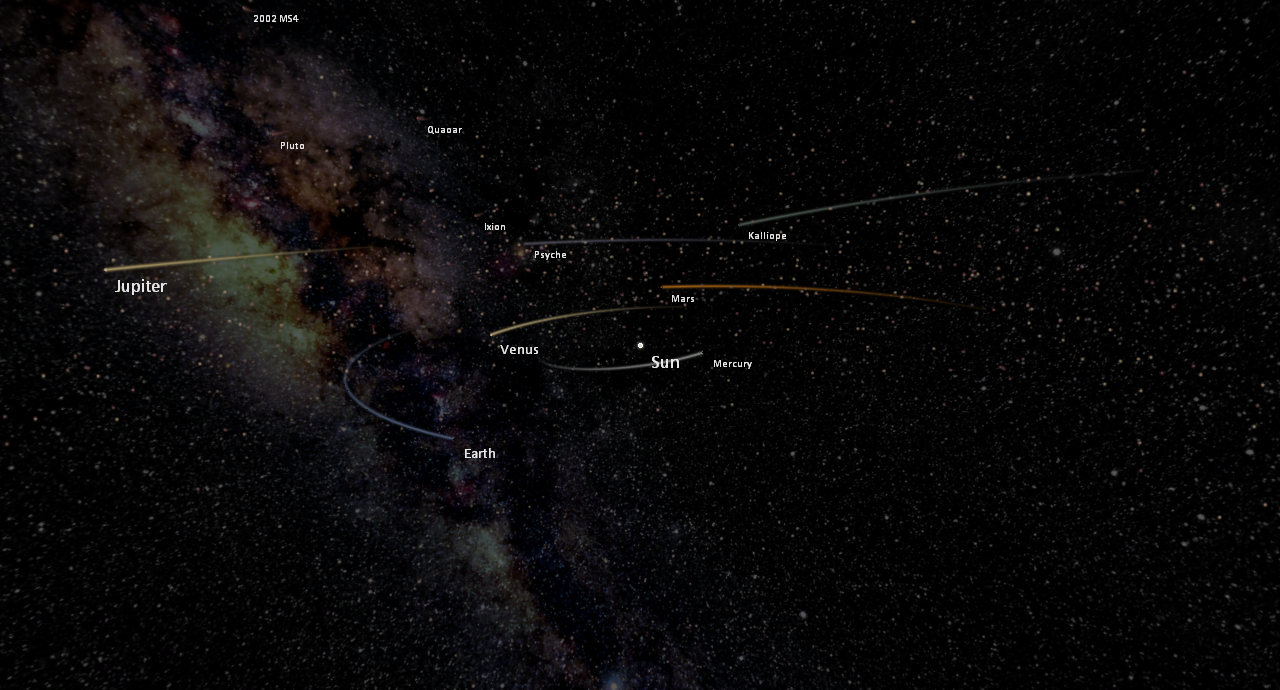
Universe Sandbox
When I logged on to Steam the other day, I came across an interesting little program called Universe Sandbox. After a bit of hemming and hawing, I decided to give in to my curiosity and purchase it.
I hesitate to call it a ‘game’ since it’s more of a simulation than anything else. Basically, the whole point of Universe Sandbox is to have fun mucking about on a cosmic scale. See what happens to our solar system if you make the sun 200 times larger! Bombard the Earth with asteroids and giant teapots! Tinker with the planets’ orbits and watch the hilarity that ensues! The whole thing is entirely open-ended, though you can try to win various achievements through Steam.
If you grow tired of molesting our own solar system, you can make your own from scratch. Many of my attempts ended in carnage since my planets have a nasty habit of getting sucked into the stars that are supposed to anchor them (then again, maybe I shouldn’t be using Mu Cephei as the focal point of my solar system!). Eventually, after a lot of trial and error, I managed to figure out the sweet spot that ensures a stable orbit.
Perhaps the greatest thing about Universe Sandbox is that it’s a scientifically accurate toy, so your inner nerd will have a field day with it. If you’re not careful, you might actually find yourself learning something. It’s also a bargain at $9.99 if you get it through Steam.
Recommendations, please
I have an idea for a new series bouncing around in my brain. It’s still in the earliest stages of life, so I can’t go into much detail about it right now. It will, however, be something of a change for me since it will be science fiction rather than fantasy. However, since I have more than enough Ptahmose-related stuff on my plate at the moment, it’s going to be a while before I devote any serious effort to this new project.
In the meantime, however, I’d like to broaden my exposure to sci fi. So far, my experience of the genre has been confined to The Hitchhiker’s Guide to the Galaxy (plus some of its sequels) and several books set in the Star Wars expanded universe. But I was hoping that you, dear readers, might be able to recommend some good reads. So if you have any recommendations, please leave them in the comments!
Truth in fiction
I was rudely awakened this morning by the fire alarm. As I waited outside for the all clear to return to my cozy bed, I decided to download a sample of Wilbur Smith’s Warlock on my iPhone. Warlock is a fantasy novel set in ancient Egypt and I had been meaning to check it out for some time, but I never managed to get around to it until now.
By the end of the first page, it became apparent that artistic license was going to be the order of the day. I had hoped that Warlock would be a work of historical fantasy on par with Susanna Clarke’s Jonathan Strange & Mr. Norrell, but Smith took so many liberties with the past that it had a negative impact on my ability to enjoy the story.
Now I get the fact that this is a novel and not a history textbook. I also understand that artistic license is often necessary. But if you’re going to set your work in a real-world society, I think you have to adhere to a certain basic standard of authenticity. Populating your version of ancient Egypt with people named “Lostris” and “Memnon” is like writing a story about feudal Japan with characters named “Tiffany” and “Bartholomew.” If you’re going to fudge that many details, why not just go all the way and set your story in a wholly fictional world of your own creation?
Let me make one thing clear, though: I’m not saying that Warlock is a bad book because it lacks authenticity. It’s just not the sort of book I want to read. I think I’ll download something by C. J. Sansom instead…
Revisions, revisions
I’ll be honest: revising a novel after a beta read is probably my least favorite part of the writing process. Compared to the adventure of coming up with a plot and writing the first draft, post-beta revisions tend to be something of a chore. By that point, you have your plot and your characters pretty well nailed down, so most the changes you’re making are mundane tweaks and typo-fixes. And, vital as they may be, it’s hard to get fired up about moving commas and adding dialogue tags. True, you do get to write the occasional new scene, but such creative bursts are usually few and far between at this late stage.
I think I may have figured out a way to make the revision process a little bit less of a hassle though. Since most of my beta readers made their comments using Word’s track changes feature, it occurred to me that I could merge all their changes into one master document. This makes things a lot tidier since you don’t have to have a gazillion documents open at once. Also, since Word allows synchronous scrolling when you’re viewing two documents side-by-side, it’s easy to keep track of the line-by-line comments.
Some of my beta readers made their comments in a separate document instead of using the track changes feature and I ended up having to go through and add them to the master list manually. For simplicity’s sake, I think that from now on I’m going to request that everyone make their comments alongside the text itself.
Now that everything is set up, I’m cautiously optimistic that I’ll be able to move quickly through the revisions. With any luck, they’ll be done within a week to ten days. Then I will probably have a very limited gamma read, largely for the purpose of hunting down the last remaining typos. Once that’s done, it will be time to declare the writing process finished and start sending out query letters.
 Codex Lochianus