Doctor Who: “The Time of the Doctor”

It’s official: there’s a new Doctor in town. Matt Smith has handed the TARDIS keys to Peter Capaldi in the much-balyhooed Christmas special “The Time of the Doctor.” As a newcomer to the Whoniverse, this was the first time I’d actually seen a regeneration in ‘real time’ as opposed to watching it several years later on Netflix, and I thought the whole thing was something of a mixed bag.

Basically, a veritable “Who’s Who” of the Doctor’s enemies descended on Trenzalore so they could besiege him in a town called ‘Christmas’ that looks like it was built from Department 56 houses. Meanwhile, the Time Lords (who were revealed to be trapped in a pocket dimension in the 50th anniversary special), are trying to make a comeback by sending messages through the cracks in the universe that first appeared in series 5. The message is simply “Doctor Who?”; if the Doctor responds by telling them his real name, his fellow Time Lords will know they’ve found the right universe and burst in like the Kool-Aid Man.

The Doctor knows that, if he allows the Time Lords to return, it will simply reignite the Time War. At the same time, he’s determined to protect the people of Christmas and their cutesy, overpriced ceramic houses. He ends up spending 300 years defending Trenzalore, and he’s convinced that he’s finally going to bite the bullet since Time Lords are limited to thirteen incarnations[note]Even though Matt Smith’s Doctor has always been called Eleven, he’s technically the thirteenth Doctor when you take into account the War Doctor and Ten’s aborted regeneration in “Journey’s End.” The notion that Time Lords are limited to thirteen incarnations dates from “The Deadly Assassin.”[/note].

Obviously, the BBC is not going to let a technicality like that get in the way of such a lucrative franchise, so it was pretty much a given that they’d find some way around the regeneration limit. Unfortunately, their solution was somewhat hamfisted: the Doctor’s companion, Clara, talked to the Time Lords through the crack-in-the-universe and begged them to help him, saying that “the Doctor” was his name for all intents and purposes. This somehow convinces them to deliver a burst of extra regeneration energy through the crack, which the Doctor uses to slaughter the Daleks who are about to destroy Christmas. It all seemed too convenient, and if they could deliver the regeneration energy, I don’t know why they didn’t just break through then and there.

The pacing of “The Time of the Doctor” also felt rushed. The assembly of the Doctor’s enemies never really had a chance to feel menacing since it pretty much came out of the blue[note]Unlike earlier series, series 7 didn’t have any kind of overarching plot, so “The Time of the Doctor” pretty much stood on its own. I think the Siege of Trenzalore would have felt a lot more important if it had been foreshadowed throughout the series.[/note]and most of the enemies only got cameos. And while Steven Moffat did his best to wrap up existing plot threads, most of that material seemed better suited to a behind-the-scenes feature rather than an episode.

The episode did do a nice job of letting Matt Smith show off his acting chops. Although Eleven has never been my favorite Doctor (I’m a Ten man, myself), Smith is an excellent actor who arguably brought more nuance to the role than any of his predecessors (at least as far as the revived series is concerned–I haven’t seen any of the pre-2005 stuff). Smith was especially good at playing the aged Doctor after 300 years on Trenzalore. Done wrong, it could have degenerated into farce, but Smith managed to capture an old man’s physicality remarkably well.

I also loved Eleven’s final soliloquy. Capturing the essence of an entire character in a single piece of dialogue is no mean feat, yet Moffat managed to write a fitting tribute to Eleven. It had an understated poignance that stood in marked contrast to the overwrought melodrama of Ten’s sendoff.

Brief as it was, Karen Gillan’s cameo as Amy Pond also deserves a mention. The stories of Eleven and Amy were uniquely intertwined, so it was fitting that he should share his final moments with her, even if she was just a figment of his imagination.

Sadly, it will be a while before we get to see what Peter Capaldi’s Doctor is like. They haven’t even started filming series 8 yet, so we might have to wait until Fall of 2014 for new episodes. Damn you, British brevity!


Once Upon a Time: “Going Home”

After weeks of tedious Neverland episodes, Once Upon a Time has finally emerged from the doldrums. Last Sunday’s mid-season finale, “Going Home,” closed the book on the Peter Pan storyline and sent the plot off in new and unexpected directions.

At the end of the previous episode, Pan!Henry stole The Curse from Regina in a bid to turn Storybrooke into the new Neverland. I’d been wondering how he was going to cast it since it has a rather nasty material component (the heart of the thing you love most). As far as I can tell, Pan never loved anyone except himself, and ripping out his own heart to cast The Curse would be rather counterproductive.

But, as Pan!Henry helpfully explains to Felix, love isn’t just romance or a familial bond. It can also be loyal friendship, and Felix has always been devoted to Pan. Sadly, Pan repays this loyalty by ripping out Felix’s heart and crushing it to dust before dropping it into the magic wishing well along with the other ingredients for The Curse. Great clouds of green smoke start billowing out of the well, letting us know that something wicked is coming to Storybrooke.

Naturally, the only way to stop The Curse is with the aid of a magical MacGuffin: the wand of the never-before-mentioned ‘Black Fairy.’  Apparently, the Blue Fairy/Mother Superior had it stashed in the convent, and Hook, Charming, Neal, and Tinkerbell rush off to find it. They go to the chapel, where the Blue Fairy is apparently lying in state after being killed in the previous episode, only to run into Pan’s shadow. There’s a CGI fight and Tinkerbell ends up trapping the shadow in Neal’s coconut nightlight thingy before throwing it onto a very conveniently located fire. Once the shadow is dead, the Blue Fairy springs back to life and hands over the wand. Oddly enough, the other townspeople seem pretty blase about her sudden revivification.

Fun fact: evil magical shadows can't penetrate wooden pews.
Photo Credit: ABC/Jack Rowand

Stopping The Curse will also require the destruction of the scroll on which it was written. In order to get it, the townspeople decide to pull a reverse Freaky Friday and switch Pan and Henry back into their proper bodies. As a precaution, Rumple decides to slap Greg and Tamara’s (remember them?) anti-magic bracelet on Pan’s arm so that he’ll be powerless when he returns to his body.

The body-switch spell works perfectly, but alas, Rumple forgot that Pan was Greg and Tamara’s boss, so the cuff doesn’t work on him. Pan promptly transfers the cuff to Rumple’s arm, divesting the Dark One of all his tricks. Pan also takes the opportunity to rub salt into the wound by telling his son that he never loved him, not even for a moment. Ouch. He leaves Rumple on the floor, confident that his father will revert to his cowardly nature now that he can’t hide behind his magic.

I really like the following scene where Rumple struggles to get the cuff off. For a moment, it looks like he might hack off his hand with a cutlass, which is a nice little callback to how he deliberately injured himself in order to get out of fighting in the Ogre Wars.

Meanwhile, Henry is reunited with his body and has a nice group hug with his family. Regina takes The Curse and immediately collapses. When she wakes up, Pan arrives and freezes everyone as he tries to figure out who to kill first. But he’s stopped by Rumple (who didn’t cut off his hand after all), who reminds Pan that he isn’t the only one with a detachable shadow. Rumple’s shadow returns with the Dark One dagger that Rumple hid when he was in Neverland, which Rumple uses to skewer his dad.. Pan transforms back into a middle-aged man, and there’s a sweet little moment as Rumple kisses his dad right before they poof away in a cloud of smoke. It’s hard to believe that Rumple is actually gone for good when a tertiary character like the Blue Fairy didn’t even stay dead for an entire episode, but it was still a very touching scene. It was also a nice way for the writers to fulfill the longstanding prophecy that “the boy” would be Rumple’s undoing.

The rest of the episode is pretty much a conga line of sadness. Regina says that the only way to save everyone from The Curse is to transport them back to the Enchanted Forest, but Henry, having been born in the Land Without Magic, won’t be able to come, though Emma can stay with him because she’s the Savior. As always, magic comes with a price, and Regina’s price is that she’ll never be able to see her beloved son again. Emma and Henry will also lose all their memories of Storybrooke and its inhabitants.

With Green Clouds of Doom rushing across town, Henry and Emma say their goodbyes, and I loved how Henry finally told Regina that he was wrong about her: she wasn’t a villain after all, and he loved her. As a final gift to Emma and Henry, Regina gives them false memories of a happy life together, one where Emma never gave Henry up for adoption. Regina re-casts The Curse to send everyone back to the Enchanted Forest, and her Purple Clouds of Doom envelop everyone just as Emma and Henry cross the town line in her trusty yellow Beetle.

We then jump ahead a year and see Emma and Henry going about their usual morning routine in New York City. It’s all very happy and domestic, but then there’s a knock at the door. When Emma goes to answer it, there’s a hunky pirate on her doorstep who breathlessly tells her that her parents are in trouble. She’s like “WTF?” and Hook tries to make her remember using True Love’s Kiss (TM), but she responds by kneeing him in his treasure chest before slamming the door in his stubbly face.

I swear I don't just watch the show for the eye candy.
Gratuitous Captain Hook pic. You’re welcome. Photo Credit: ABC/Jack Rowand

Although there were some uneven moments (Felix being the thing that Pan loved most seemed like a bit of an asspull, as did the Black Fairy’s wand) and the repeated bits about hope and happy endings got a bit saccharine, the final moments more than make up for those deficiencies. Even though we viewers know that the Storybrookers aren’t saying goodbye for realz (this is a mid-season finale, not a series finale!), the scenes between Rumple and Pan and Regina, Emma, and Henry still tugged at the heartstrings. I also liked how the episode contributed to Rumple and Regina’s character development. Regina finally shed her villain persona, while Rumple showed once and for all that he’s not a coward.

The only bad news is that the show is on hiatus until the spring premiere on March 9. The promos suggest that the Wicked Witch of the West will become the new Big Bad. It will be interesting to see her as a villain again after Gregory Maguire rehabilitated her in Wicked.

Once Upon a Time: “Save Henry”

I’ll be honest, I have mixed feelings about season 3 of Once Upon a Time. The Neverland plot has been plodding along at a glacial pace, and the persistent relegation of Regina to the background is rather annoying (seriously, taking one of the most interesting characters in the show and giving her one or two lines an episode doesn’t make for compelling TV). But in last Sunday’s episode, “Save Henry,” Regina finally gets to do something beyond occasional snark AND we finally get to leave Neverland behind. That’s definitely a win-win situation.

The flashback portion of the episode seems to answer one of the core mysteries of the show: why the hell did Regina decide to adopt Henry in the first place? To some extent, it’s always felt like something of an ass pull since the Regina we saw in the Enchanted Forest wasn’t exactly agonizing over the ticking of her biological clock, though season 2’s “Welcome to Storybrooke” helped lay the groundwork for the explanation by showing us how Regina bonded with Owen.

Maybe if I cast "Silence" on him...
Photo credit: ABC/Jack Rowland.

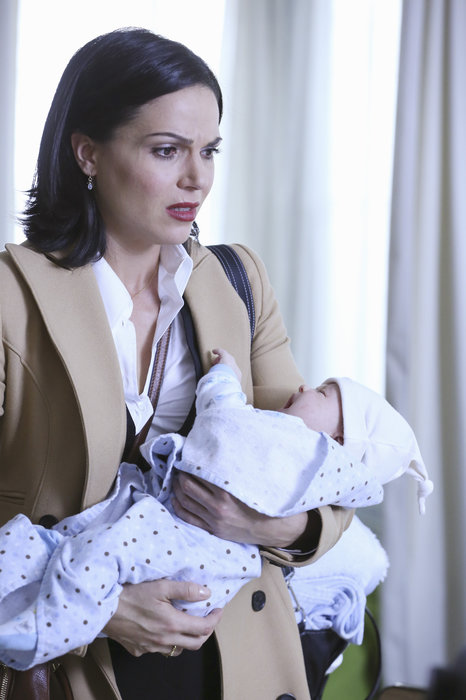
In “Save Henry,” we learn that Regina’s desire for a child is shown to be a side-effect of her decision to commit patricide in order to cast the Curse. That left her with a hole in her own heart, though it can’t be too vexing since she waits 18 years before deciding that a child might help fill the void. Rather than jump through the hoops of the standard adoption process, Regina decides to ask Mr. Gold for help (I have to admit that I snickered when he thought that Regina was asking him for some, ahem, biological help with obtaining a baby). Since this is Mr. Gold, he has no problem sourcing a baby in Boston.

After agreeing to a closed adoption, Regina now has her very own bouncing bundle of pain-in-the-ass, but it isn’t long until little Henry’s incessant crying is driving her up the fucking wall. She takes Henry to Dr. Whale, who suggests that it’s vaguely possible that Henry has some sort of genetic problem, which seems like a naked plot contrivance designed to give Regina a reason to send her lackey Sydney (remember him?) on a hunt for the identity of Henry’s birth mother.

When Regina finds out that Henry’s mother was discovered outside Storybrooke just after the Curse struck, she yells at Mr. Gold, accusing him of playing his own game. Although he feigns confusion, the show definitely gives the impression that he knows more than he lets on. If that is indeed the case, the writers have a problem on their hands. Previously, they said in an interview that Mr. Gold didn’t remember that he was Rumpelstiltskin until Emma came to Storybrooke. Although this has never been explicitly stated in the show itself, it’s been heavily implied.[end]Mr. Gold has an obvious reaction when learning Emma’s name in the first episode, and when Regina goes to see him in “Welcome to Storybrooke,” he seems oblivious to his past life as the Dark One.[/end] At this point, it’s hard to say whether this is a retcon or just careless writing.

Speaking of retcons, there’s an unambiguous one later on in this episode. After flirting with the idea of handing Henry back to the adoption agency, Regina decides that the best thing for her to do is take a magic roofie potion that will make her forget about Henry’s birth mother as well as Mr. Gold’s shady baby-procurement methods. But this causes all sorts of plot problems, since in the first season it’s clear that Regina remembers how she got Henry, and it’s also strongly implied that she knew who Emma was the moment she showed up in Storybrooke. So what happened to the magic roofie? Did it wear off? Did Emma’s arrival nullify it? It’s not at all clear, and the writers appear have created a rather nasty plot hole.

The present-time storyline is focused, as the title of the episode suggests, on saving Henry, who is now comatose after giving his heart to Peter Pan (literally) in the previous episode. They can’t revive him, so Regina casts a preservation spell on him to keep him fresh while they go after Pan. For some reason, this preservation spell will only last an hour even though Regina used a similar spell to keep her dead boyfriend on ice for years.

Although Regina wants to extract Pan’s whereabouts from the Lost Boys through torture, Emma manages to get them to spill the beans with nothing more than a liberal application of maternal love. Apparently, he’s at the “Thinking Tree” (which sounds like it’s the Giving Tree‘s more intellectual sibling). Emma, Regina, and Snow White go hunting for Pan and find Pandora’s Box waiting for them in a clearing. Because Snow is kind of an idiot, she immediately grabs it. Obviously, it’s a trap, and the three ladies are tied to the tree by CGI vines. Pan comes down to snark at them, telling them that the tree will feed off their regrets. At this point, I was afraid the show would give us a long, angsty scene where the three of them come to terms with their regrets, but instead, Regina points out that she doesn’t regret anything she’s done and bursts through the vines. She rips Henry’s heart out of Pan’s chest without further ado, and I rejoice at the welcome acceleration of the plot.

After Henry gets his heart back, everyone piles on board the Jolly Roger to go home. Rumpelstiltskin is reunited with his son (aww!) and good vibes abound. Regina is somehow able to tether the Evil Shadow that serves as the genus loci of Neverland to the Jolly Roger‘s sail (they trapped it in Neal’s coconut nightlight earlier in the season), which allows them to fly away. However, they inexplicably left Henry unguarded down below, and he’s attacked by Peter Pan. Pan can’t re-take Henry’s heart since Regina at least had the foresight to put the magical version of The Club on it, so he tries to tear Henry’s shadow away instead.

Up above, Rumpelstiltskin realizes that something’s wrong and runs downstairs to trap Pan in Pandora’s Box (turnabout is fair play, after all). But while Pan is struggling against the pull of the box, Henry’s eyes flash, which kind of telegraphs the last-minute plot twist. Pan and Henry have done a Freaky Friday, so Henry’s now trapped in the box and Pan is free to cause more mischief. The episode ends with Pan!Henry telling chief Lost Boy Felix that it’s “time to play.” Dun dun duuuuun…

Despite the retconning and some shaky aspects of the Henry Adoption Plot,[end]I find it a little hard to believe that the adoption agency would just let Regina change her mind about giving Henry back at the last minute, considering they already had another placement lined up. Speaking of which, the other placement turned out to be Wendy’s brothers, who wanted to hand Henry over to Pan. Somehow, I’m not sure that an adoption agency would see two seemingly college-aged brothers as ideal candidates for a baby’s new parents![/end] I liked this episode. I’m so glad to be out of Neverland at last. This season’s episodes have crawled along at a snail’s pace, and having everyone team up to search for Henry has really thrown the show’s dynamic off. 

The Legend of Korra disappoints, again

The Physicist and I finally got around to finishing Book 2 of The Legend of Korra, and I was underwhelmed, to say the least. Warning: spoilers ahead.

First of all, what the hell is up with Jinora? Her last-minute-save-the-world intervention seemed like a total ass-pull, and it was hard to tell exactly what was going on. If you’re going to have a tertiary character save your protagonist’s ass, you need to do a much better job of foreshadowing it–a propensity for cuddling cute spirit animals isn’t enough.

Korra’s duel with UberUnalaq was also unsatisfying. It didn’t really have any emotion–it was just two giant beings slugging it out like they’re in a Godzilla movie. I would have liked to have seen more of an emotional conflict between the two of them. Unalaq is Korra’s uncle and he had her father thrown in jail on trumped up charges, but Korra basically reacts to him like he’s a random Monster of the Week.

The other problem with Unalaq is that his character development was incredibly uneven. At first he starts out as a well-intentioned extremist, but he abruptly becomes a garden-variety villain in the last few episodes. I would have liked to have had a better idea of why he thinks that unleashing Vaatu is going to make the world a better place. Even if he thinks that the spirits have gotten a raw deal, releasing the spirit of chaos and darkness isn’t exactly the next logical step. Now it seems that he just did it for the Evulz, and that’s unsatisfying.

Compare that with Zuko and Azula from the first series: we had a much better idea of what made them tick and why they acted the way they did. Because the audience actually got to bond with them, they were much more satisfying as villains.

The lack of character development isn’t confined to Unalaq. Korra suffers from it, too. The problem is that she doesn’t seem to learn from her mistakes. At the end of Book 1, she supposedly learned that it’s okay to rely on others, yet when Book 2 began, she was back to being a lone wolf. It also doesn’t help that she remains a flat and uninteresting protagonist. She needs to have more depth beyond a kick-ass-and-take-names attitude. And I wish the writers would lay off the Korra/Mako relationship drama. It’s tepid at the best of times since the two characters don’t really have any chemistry.

I was also kind of annoyed by the whole Varrick subplot. It felt like little more than a series of plot contrivances, and in the end, it didn’t really go anywhere. Varrick certainly isn’t punished for his crimes: the last we see of him, he’s escaping with his loyal assistant on his back (trust me, it makes sense in context).

I think a lot of Korra’s problems ultimately stem from the decision to have these truncated seasons. Filler episodes are not bad. Done right, they can help the characters grow and advance the meta plot. I think the best example of this is probably “The Beach” from Book 3 of The Last Airbender. That episode really had nothing to do with the main plot, but it did a great job of giving us background info about Zuko and Azula. There’s nothing like that in Korra, which is why everyone seems so damn flat.

On a more positive note, I liked that the writers actually did something risky by having Korra’s connection to her past lives severed permanently (?), though the impact of this change was somewhat reduced by the fact that Korra never really had much of a relationship with the past Avatars.  That could set the stage for some truly interesting plot developments in Book 3, provided they don’t go and hit the reset button within the first few episodes.

I enjoyed watching the interactions between Tenzin, Bumi, and Kya. We don’t really know what Aang was like as an adult, so it’s interesting to hear what his kids thought of him. It seems that he wasn’t exactly a model father, and he played favorites with Tenzin since Tenzin was the only airbender among his progeny. One thing I’ve always liked about Aang is that he’s generally not a Gary Stu. He’s always had flaws, and that made him a lot more interesting.

Finally, I really liked the art of Book 2, particularly the glimpses of the Spirit World and the flashbacks that made up “Beginnings” parts 1 and 2. Avatar has always been exceptionally well animated, and Book 2 has some of the most stunning episodes of the entire series.

Despite my disillusionment with Korra, I’ll still watch Books 3 and 4. I just hope it gets better….


Thoughts on finishing Merlin

The Physicist and I finished watching Merlin this evening, and I have to say, I wasn’t a fan of the series finale.

My biggest gripe is that so many people spent the finale holding the Idiot Ball. Why was Gwaine stupid enough to spill state secrets to some cheap doxy he’d just met? Why the hell didn’t Merlin ask the Dragon for help earlier? Why did Percival and Gwaine think that they had any hope of bringing down a powerful sorceress on their own? The answer, of course, is that they had to set up Arthur’s death, but they still made the characters seem woefully stupid.

I think it also sucks that we never got to see the promised golden age of Albion. Throughout the entire series, we’ve been told that Merlin is destined to help Arthur unite the kingdoms and bring about an age of wonder, but it never happens. All we get are some passing references to a few years of prosperity occur in between seasons 4 and 5, and the show ends with Merlin being consigned to a rather lonely existence as he waits for his boyfriend to come back from the dead. This makes the whole series seem futile.

It also doesn’t help that season 5 as a whole was rather lackluster. While it was nice that they finally moved away from the rigidly episodic format of the earlier seasons, they frittered away too much time on inane side plots like Evil!Gwen. I also missed the lighthearted tone of the earlier seasons. What is it with campy, fluffy shows going all dark and gritty as they go on? Xena and Buffy did the same thing, and I think it usually hurts the show.

I did appreciate the fact that Arthur’s character finally got to develop in season 5. In the early seasons, they had a nasty habit of hitting the Reset Button every time he learned a lesson, but towards the end he finally got to grow and mature. Sadly, the same can’t be said for Merlin. I suppose one could argue that he’s a bit harsher in season 5, but I would’ve liked to have seen more pronounced development. It was particularly annoying that, even at the very end, he was still blurbling about how his destiny was to serve Arthur. I think it would have been much cooler if Merlin had outed himself as a sorcerer before the final episode. It would have been neat to see Arthur come to grips with that in normal circumstances instead of the deathbed acceptance we got.

Oh, and while we’re on the subject of season 5, I thought the way they handled Mordred’s betrayal sucked. Having him ragequit Camelot over some chick who’s never been seen or mentioned before was just stupid. In the episode, he kept claiming that they were besties from way back, but it would have been nice if they’d done a better job of working that particular relationship into the plot.

Despite my complaints about the end, I have to say that I enjoyed Merlin overall. It’s not going to go down as one of my all-time favorite shows, but it was fun to watch. Colin Morgan and Bradley James are both fine actors (Morgan did a particularly nice job in the finale—those were some heavy scenes, yet he never seemed overwrought or melodramatic) and they had great chemistry together. With any luck, they’ll collaborate again at some point.

Reflections on Avatar: The Legend of Korra Book One

WARNING: SPOILERS AHEAD!

Book One of Avatar: The Legend of Korra came to an end last month. I started watching the show with high expectations, but they swiftly took a nosedive as it progressed. Sadly, the season finale did nothing to shake me from my apathy.

I approached the show as a huge Avatar fan. I loved it so much that I purchased the boxed sets of all three seasons, which is something I rarely do since I’m such a cheapskate. I re-watch them regularly, and I can honestly say that I enjoy almost every episode (with the exception of “The Great Divide,” of course).

When I heard that they were going to make Korra, I was thrilled. I was a bit disappointed that we wouldn’t be seeing more of the original characters, but the steakmpunkesque setting looked intriguing. But after the first few episodes, my enthusiasm for the show all but vanished, and I continued watching out of a sense of duty rather than enjoyment.

Korra was originally intended as 12-episode miniseries, but that was eventually increased to 52 episodes divided into four ‘books,’ with each book having a different plot arc. The original series, on the other hand, had 61 episodes spread over three books. Because Korra has shorter books, the plot is forced to move along at a much faster pace, without any filler episodes. That could have been an asset, but instead it turned out to be a problem.

The show’s pacing struck me as woefully uneven. The first part of the book is dominated by the pro-bending storyline, which gets jettisoned midway through so the Amon storyline can take center stage. After a fairly sedate beginning, viewers are subjected to plot whiplash as the remaining episodes zoom from battle to battle.

I wish the pro-bending storyline had been pruned a bit because it really wasn’t all that interesting. The institutionalized nature of the combat managed to make bending boring. At their core, all the pro-bending scenes were the same. Two teams would meet in an arena and lob elements at each other. They were a poor substitute for the varied combat shown in the original series.

The Amon storyline is less repetitious, but things move so quickly that everything seems curiously devoid of impact. The finale contains some genuine drama when Amon manages to strip Korra of most of her bending skills. For a few moments, I thought that the second part of the season would focus on her struggle to regain her mastery of the other elements, and I was genuinely excited.

Alas, Avatar Aang comes along in the last few minutes of the episode and restores her bending while dispensing some pap about how her recent suffering has made her a true Avatar. Apparently, Korra can now tap into her spiritual side, but it’s kind of hard to see this as a momentous achievement when her lack of spirituality hasn’t been mentioned since the first episode.

Of course plot problems can be overlooked if the characters are sufficiently engaging. Sadly, Korra’s weren’t. I think the lack of filler episodes really hurt the characterization. The original series handled filler episodes very well because they often ended up being more character-driven. “Zuko Alone,” “The Tales of Ba Sing Se,” and “The Beach,” are all great examples of how the original series managed to flesh out the characters.

But there wasn’t room for anything like that in Korra, and so everyone remained pretty one-dimensional. Compared to Aang, Korra’s personality seemed pretty flat. She felt like a generic Strong Female Character, and I think it’s because we weren’t allowed to get to know her gradually. She also didn’t seem to face many interior struggles. True, she had problems with the spiritual side of being the Avatar, but that it’s not really a ‘struggle’ when it’s mentioned once at the beginning and then forgotten about until the finale.

Her relationship with Mako felt similarly flat. There was never really any chemistry or tension between them. True, Mako had the hots for Asami for a while, but she might as well have worn a nametag reading “Hi, my name’s Asami, and I’m a plot complication.” There was no reason to think of her as a credible rival to Korra.

And then there’s Amon, the main villain of the book. Although he gets points for having a plot that’s more sophisticated than the usual KILL, KILL, KILL!!!, he’s still rather bland until the finale fleshes out his backstory a bit more. He can’t really hold a candle to either Zuko or Azula from the first series.

I haven’t totally given up on Korra, and I’m willing to watch a bit of Book Two to see if things get better. But I certainly won’t be rushing out to buy Book One anytime soon.

Unnatural History

When I heard that Cartoon Network had a series set in a natural history museum, I had to check it out.  Unnatural History is a new live-action series starring Kevin G. Schmidt, Jordan Gavaris, and Italia Ricci.  Schmidt plays Henry Griffin, the son of anthropologists who has traveled to all kinds of exotic locations with his parents.  To give him more stability, his parents have sent him to live with his uncle and cousin Jasper (played by Gavaris) in Washington, DC.  Rounding out the gang is their Strong Female Friend (TM) Maggie, played by Ricci.  The three of them attend a high school located in the fictional National Museum Complex (which is clearly modeled on the Smithsonian).

The episode I saw involved Jasper curating an exhibit in the museum (apparently, the museum lets one do this every year).  His exhibit is about the Pony Express and his cousin Henry is eager to help him make it a success.  Eventually, they go off on a search for some missing silver from a mine in Nevada that turns out to be contaminated with some nasty bacteria.  Poor Jasper gets sick, and it’s up to Henry to save the day.

Overall, I thought the show was decent.  The plot is outlandish, but fun.  I know next to nothing about the Wild West, so I can’t comment on the accuracy of the underlying history, but I have to give props to the writers for basing the mystery around something other than a mummy or a supposedly cursed jewel.  I also like the fact that, although Jasper is portrayed as an excellent student, the writers resisted the temptation to turn him into a pencil-necked geek with Coke-bottle glasses and a pocket protector.

The show’s major downside is that Henry is in danger of becoming a Mary Sue. Because Henry has traveled the world with his parents, he’s acquired a very diverse skill set and, when he’s forced to use one of his skills, the audience is treated to a little flashback to illustrate how he acquired it.  In moderation, it’s a cool device, but the writers need to be very careful that they don’t rely on it too much, lest Henry become a perfect cardboard cutout rather than a believable character.

What I’ve watched: Samurai Champloo

Last Sunday, the Physicist and I finished watching Samurai Champloo.  Overall, I really enjoyed it, though, like many anime, it suffered from a craptastic ending.

Champloo is set in a fictionalized version of Edo-period Japan that borrows heavily from modern life (e.g. there’s baseball and hip-hop culture).  Ordinarily, the historical anachronism would bother me to no end, but, in the context of the story, they work.  The plot follows a fifteen year old girl named Fuu and the two roving samurai, Jin and Mugen, who accompany her on her quest to find the Samurai Who Smells of Sunflowers.

But the quest for the Sunflower Samurai isn’t actually that important, and most of the series is about the journey itself and the trio’s adventures along the way.  The series is well written and, unlike a lot of other anime characters, the characters in Champloo develop a bit over the course of the series.

My only real objection to the series is the ending.  The writers pulled some random villains out of left field to fight the heroes and the result is thoroughly unsatisfying.  There are also a number of WTF moments that left me scratching my head.  But overall, I really enjoyed Champloo and I’d give it a final grade of A-.

What I’ve watched: NieA_7

I really wanted to like NieA_7.  I really did.  When the Physicist and I first started it, it seemed like it was going to be a lighthearted romp.  The characters were quirky and interesting and the series’ premise of aliens living peacefully among humans seemed like it could be really cool.

Alas, our enthusiasm was short lived.  The characters in NieA_7 manage to be even flatter than those in Wolf’s Rain.  Niea, the titular character, is amusing to watch, but her antics never progress beyond pratfalls.  Her roommate Mayuko spends the entire series moping and sulking like she’s the Queen of Emoland.  The other characters occasionally have funny lines, but, for the most part, they just exist.

Given how flat the characters are, it should come as little surprise that the plot leaves a lot to be desired.  Not much actually happens beyond Niea hamming it up and Mayuko sulking.  Subplots are hinted at: the bathhouse where Mayuko lives is facing financial difficulties and Niea has a difficult relationship with the other earthbound aliens.  But neither of these subplots end up going anywhere and few things about the series’ underlying mythology are ever explained.  For example, towards the end of the series, the wreck of the mothership that brought the aliens to earth disintegrates into a multitude of shining lights.  It’s hinted that this is a Big Deal, but we’re never told what the hell happened.

Also frustrating was the awkward attempt at drama.  After about seven episodes of lighthearted comedy, NieA_7 tries its hand at drama and fails miserably.  Drama only works if you have a compelling plot and interesting characters.

Pros

Funny.

It’s short.

Cons

Flat characters.

Forgettable plot.

Deliberate obscurity.

FINAL GRADE: C.

What I’ve watched: Wolf’s Rain

My Grade: C-

Every Sunday, my friend and I get together to watch anime and have dinner.  Over the years, we’ve watched a number of great series, including Fullmetal Alchemist, Cowboy Bebop, and Avatar: The Last Airbender.  We’ve also watched some not-so-great series, such as Bleach and Gilgamesh.  Recently, we finished Wolf’s Rain and, I have to say, it falls into the not-so-great category.

Let me start out by saying that I had high hopes for WR.  I first became aware of it several years ago when I found its closing theme (“Gravity”) used in some YouTube video.  But I promptly forgot about it until last December when the Physicist and I were looking to start a new anime series.  Much to my subsequent embarrassment, I suggested WR.

Like Bleach, WR gets off to a good start.  The whole premise of wolves masquerading as humans in a postapocalyptic, vaguely steampunk world was intriguing.  But it all goes downhill from there.  Most of the characters are so poorly developed that you don’t really care when they meet their Inevitable Tragic End, nor do you care about their inane subplots.  And the ending manages to be both depressing and ludicrous at the same time.

And then there are the recap episodes.  Despite the fact that the series is only thirty episodes long, WR has no less than four consecutive recap episodes in which the story so far is retold from the perspective of four different characters.  Of course they don’t end up being all that different from one another, so it just gets old really fast.  The whole thing just reeks of a production delay.  The only good thing about these recap episodes is that, in the American release at least, they’re all on the same disc, so they’re easy to avoid.

PROS

Nice Artwork

Nice Soundtrack

Cool Premise

CONS

Hamfisted Plotting

Paper-thin Characters

Pointless Recap Episodes