Christmas comes early!

After years of searching, I’m finally the proud owner of Alexandre Piankoff’s The Tomb of Ramesses VI. Ramesses VI had one of the best-decorated tombs in the Valley of the Kings, and its walls were decorated with an unusually complete selection of Netherworld books. The Bollingen Foundation sponsored a photographic survey of the tomb and commissioned Piankoff to translate the texts into English. Although it was published over 50 years ago and probably went out of print shortly thereafter, Piankoff’s work is still useful because it contains the only English translations of many of these texts.

Unfortunately, second-hand copies of The Tomb of Ramesses VI tend to be quite expensive. The two-volume set usually sells for anywhere from $200-500. But in a stroke of staggering good fortune, I was able to get both volumes for $21 from a seller called Better World Books. Not only did I get a great deal, but they also donate a portion of their proceeds to various literacy-related charities.

As I waited for the books to arrive, I worried that the deal was too good to be true. Happily, my fears proved to be groundless. Both volumes are in excellent condition, and I’m thrilled with my purchase. If you’re looking for used books, you should definitely check them out.
Egyptian expeditions to Chad

This is cool:

http://www.unreportedheritagenews.com/2011/03/ancient-egyptians-made-arduous-trek-to.html

I have to admire someone who could leave the relative comfort of the Nile Valley and go off trekking through the desert.  That takes a lot more guts than I have!

The idea of a correlation between the geography of Chad and the geography of the Underworld as described in the Amduat is intriguing.  I’ve often thought that the distances mentioned were peculiarly specific and this could well explain that.

Tales of Ancient Egypt

I visited my mom over Easter and, while I was there, I had the chance to look through some of my old books.   One of the titles I came across was Tales of Ancient Egypt by Roger Lancelyn Green.  A friend of C. S. Lewis and J. R. R. Tolkein, Green was a great popularizer of world mythology and folktales. Tales of Ancient Egypt was my first exposure to ancient Egyptian literature and his retelling of the Setna Khaemwaset stories captivated me.  The sense of wonder that that little volume evoked has remained with me through the years and I owe Green an enormous debt of gratitude since his work set me on the path that would eventually lead me to Evil in Thebes.

Since I first read Tales of Ancient Egypt, I’ve read more Egyptian literature than any sane person should.  I can now see how Green took liberties with his source material.  Sometimes he bowdlerized, sometimes he simplified.  Every once and a while, he embellished for dramatic effect.  But because he was aiming to capture the spirit of his source material rather than the precise details, his renderings are often much more pleasing to the casual reader than the scholarly treatments found in Lichtheim or Simpson.

So if you’re looking for an accessible introduction to the world of Egyptian literature but don’t want to get bogged down in a sea of philological footnotes and opaque scholarly commentary (though I can’t imagine why anyone wouldn’t enjoy those things!), I highly recommend Green’s book.


Magically impotent pharaohs

Given the omnipresence of magic in ancient Egyptian society, it should come as little surprise that feats of magic are commonplace in Egyptian literature.  Their stories are filled with wise lector priests who can reattach severed heads, part the Nile, or send animated wax figures into Nubia to beat up a local chieftain.  But there is one person in Egyptian literature who never seems to work magic: the pharaoh.  In fact, in a number of stories the king is actually rescued from death or humiliation by the skills of a crafty lector priest.  This strikes me as odd.

Many of you have probably heard that Egyptian pharaohs were considered living gods.  But while Egyptian texts are quite clear that the king becomes fully divine after death, the nature of his divinity while alive is much harder to pin down.  The waters are muddied even further by the fact that kings such as Amenhotep III and Ramesses II seem to have been deified within their own lifetime and are in fact depicted making offerings to themselves.

Even if the Egyptians believed that their kings’ earthly divinity was strictly limited, that still doesn’t explain why he’s depicted as magically powerless in literature.  Lector priests aren’t in any way divine, yet they’re capable of working great feats of magic so it’s hard to see why the king couldn’t do so as well, even if his divinity doesn’t really manifest itself until after he’s dead.

It could be that this is all an accident of preservation.  After all, the existing corpus of Egyptian literature is doubtlessly just the tiniest fraction of what was originally produced.  Unfortunately, this fragmentation also makes it difficult for us to draw meaningful conclusions.  *Sigh*  On the plus side, it does mean that, as a writer, I have a lot of leeway when it comes to making up my own explanation. 😀

The limits of Egyptology

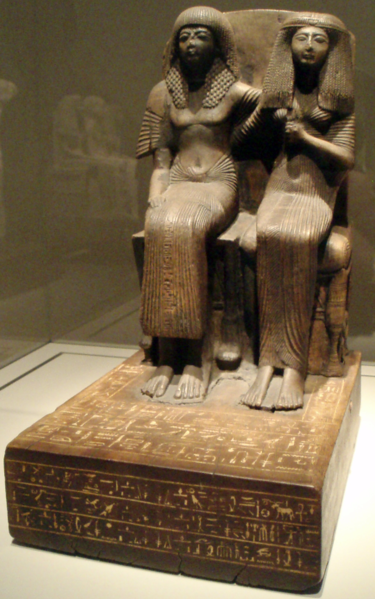
I came across this picture of a statue of Amenope and his wife Hathor this evening.

It’s a fairly typical New Kingdom statue of an aristocratic couple, but it made me think about the limits of the archaeological record.

As I looked at them sitting next to each other in a polite display of conjugal affection, I found myself starting to wonder what Amenope and his wife were like in real life.  Was he a bore?  Was she a nag?  Did they comfort each other through life’s innumerable storms, or did they quietly grow apart?  Were they happy with their lives, or did they want something more?

Egyptology has taught us a great many things about the ancient Egyptians.  But, alas, some things will always remain lost in  the past.

Ancient Egypt on the silver screen

I read today that Will Smith is planning to make a movie entitled The Last Pharaoh.  The title seems to be a bit of a misnomer since the movie is about Taharqa, one of the Nubian kings who ruled over Egypt during the Third Intermediate Period.  There’s really no way you can claim he was the last pharaoh.  In fact, he wasn’t even the last pharaoh of his own dynasty.

Apparently, Smith has hired Randall Wallace to write the screenplay.  Wallace has written screenplays for a number of historical epics, such as Braveheart, Pearl Harbor, and The Man in the Iron Mask. Interestingly, Wallace was also involved in writing  the computer game Titan Quest (quite frankly, given the game’s paper-thin storyline, he should probably leave that off his resume!).  While Wallace isn’t exactly known for his scrupulous historical accuracy, he does at least write entertaining screenplays.  That gives me hope that The Last Pharaoh might at least be enjoyable, even if it is bastardized history.

Oddly enough, ancient Egypt hasn’t been well served on the silver screen.  I’m trying to think of a truly good movie about ancient Egypt and I’m coming up blank.  Usually films about Egypt are undermined by a fatal combination of hackneyed story ideas and historical inaccuracies that make Cate Blanchett’s Elizabeth look like a scholarly monograph.  Which is a shame, really, because Egyptian culture is rich with ideas for good movies beyond the tired revived mummy trope.

More about Tutankhamun

The blogosphere has produced some good commentary on the recent JAMA article I discussed here.

The improbably-named Shoveling Ferret blog has a four-part series discussing the article:

Part 1:
http://shovelingferret.blogspot.com/2010/02/commentary-on-recent-tutankhamun.html
Part 2:
http://shovelingferret.blogspot.com/2010/02/commentary-on-recent-tutankhamun_18.html
Part 3:
http://shovelingferret.blogspot.com/2010/02/commentary-on-recent-tutankhamun_19.html
Part 4:
http://shovelingferret.blogspot.com/2010/02/commentary-on-recent-tutankhamun_8728.html

The author has an MA in Egyptology from Chicago and her commentary is often quite amusing, so I highly recommend checking it out.

Of course not everyone agrees with the conclusions of the JAMA article.  This blogger has posted an in-depth refutation of the idea that the KV55 mummy could be Akhenaten: http://www.kv64.info/2010/03/dna-shows-that-kv55-mummy-probably-not.html

I’m not a geneticist (I don’t even play one on TV), so I can’t comment on the scientific accuracy of her conclusions.  But I think there’s a very strong possibility that the ancient Egyptians at least thought the KV55 mummy was the body of Akhenaten, given its desecrated state.  There’s also the circumstantial evidence of the presence of some of his grave goods in the tomb.  If the mummy is in fact NOT Akhenaten, how do we explain these things?

The Quote of the Day though comes from Justine over at Shoveling Ferret.  She has this to say about the intricacies of Amarna-period royal genealogy:

Pedigree charts are annoying enough, but add in a heaping helping of incest and I’m just like “dude, they were all fucking each other and then they died, the end!”

The Theban Mapping Project

I promise I won’t turn this into Jason’s Boring Ass Egyptology Blog, but I encourage any of you who have even a passing interest in ancient Egypt to check out the website of the Theban Mapping Project: http://www.thebanmappingproject.com/.

While you’re there, I suggest you try out the Atlas of the Valley of the Kings.  It’s an interactive map that shows you every tomb in the valley and, in many cases, there’s a little video narrated by Kent Weeks (Director of the TMP) giving a bit of info about the tomb.  The 3D reconstruction of KV 14 (Taworset and Setnakt) is also worth a look.