The state of Torment: Tides of Numenera

WARNING: SPOILERS AHEAD!

As you know, I’ve been participating in the beta for Torment: Tides of Numenera. InXile recently released a huge patch that substantially alters the game, so I decided to jump back into the Ninth World and see the changes for myself.

The biggest change is probably that the beginning of the game has been completely retooled. The game still begins in media res with the Last Castoff plummeting to earth, and he/she still ends up within their own mind after being knocked unconscious by the fall (trust me, it makes sense in context!). But the beginning plays much differently.

There used to be a fairly involved Crisis where you had to run around to different tanks while avoiding mooks sent by the game’s Big Bad. Within each tank was a creature, and you were treated to a flashback from its life. Your choices influenced how the flashback would play out, and these decisions had an impact on the LC’s development. This Crisis presented an interesting challenge. Brute force wasn’t an option. The LC had to focus on the flashbacks, and the Specter (a ghostly companion who served as a guide) could only push the mooks away. It was a nice way to show players that TTON favors creativity over combat, though it may well have  grated after multiple playthroughs.

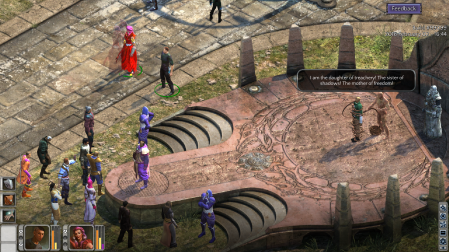
Now, the introductory Crisis is much simpler. You still have to fend off an attack by the Sorrow, but the tactical element seems to have vanished. Now, you just whack some memory specters that are being devoured by the Big Bad. The patch notes say whether this Crisis is a placeholder, but it definitely feels like one.The Big Bad looks cool, but the whole thing feels perfunctory. There doesn’t seem to be any challenge to it. Mooks spawn periodically while you’re destroying the specters, but they simply fly off without attacking.

I can see why the designers felt that the old Crisis needed improvement. There was arguably too much style and not enough substance in the early game. I loved learning about the creatures in the tanks, but I’m also the sort of person who reads every single lore book in a game. If you’re not a lore freak like me, the original introduction might have felt unbearably slow. Unfortunately, the new Crisis goes too far in the opposite direction. There’s a lot more action, and it feels more like an ARPG than an RPG.

I also think that the way the Tides are handled is unsatisfactory. The game has never really done a good job of explaining what they are or why you should care about them, and the latest patch has made them even more nebulous. You periodically see pop-up messages telling you that your alignment with this or that Tide has increased, but it feels divorced from your in-game choices (you can see numerical values for each Tide in the character screen, but the numbers don’t have enough context to be useful). In the old version, your initial Tidal alignment was determined by the choices you made during the flashbacks. The process was opaque, but it felt more meaningful than the present system. At the moment, the whole thing feels random.

The biggest problem that I’ve seen so far is combat. Despite the patch, it’s horrifically glitchy. In many cases, I couldn’t even start a fight because my first character wouldn’t respond to my orders and I couldn’t end the turn. I’ve also experienced issues with the game hanging during an enemy’s turn. There was a point where I couldn’t finish exploring an area because I came under attack whenever I loaded a game and then had to quit the game mid-battle due to bugs (I was only able to break the cycle by engineering the LC’s death!). It’s certainly caused me to make liberal use of the feedback button!

Thankfully, the game is still a ways from release (inXile recently said that the release window has been postponed until early 2017 due to localization issues), so there should be plenty of time to iron out these kinks. Despite my complaints, I’m still pleased with the game overall. The writing is absolutely top-notch, and the developers have done a fantastic job of interpreting Numenera’s innovative mechanics. I’m sure that, come release day, these problems will be nothing more than bad memories.
*SPOILERS* Thoughts on the Torment: Tides of Numenera beta

WARNING: SPOILERS AHEAD!

For almost three years now, I have been eagerly following the development of inXile Entertainment’s new cRPG Torment: Tides of Numenera. It’s been a long road, and the game’s release has been repeatedly delayed (though, as a Diablo fan, I’m no stranger to long waits!). Happily, TTON is now in beta and players can experience a sliver of the game for themselves. So far, the omens look good.

First, a caveat: TTON is very much a work in progress. This is not like Diablo III where the beta was more less identical to the finished game. InXile still has a lot of work to do. In some cases, entire areas have yet to be implemented, and the game is quite buggy (though the first beta patch has made things better). 2016-01-31.png

TTON is a spiritual successor to the critically acclaimed Planescape: Torment. It’s set in the world of Numenera, a science fantasy RPG created by industry veteran Monte Cook that is set on earth a billion years in the future. The basic premise of Numenera is that eight hyper-advanced civilizations have come and gone and a ninth is just beginning. Although these prior civilizations are long gone, remnants of their technology remain (these are the titular numenera). Most Ninth Worlders view them as magical, though the clever can sometimes use them in new and inventive ways.

The beta comprises the very beginning of the game, including character creation and the first town. You play the role of the Last Castoff, and your body was originally created to serve as a vessel for the Changing God, a mysterious figure who has figured out how to use the numenera to transfer his consciousness between bodies. When he leaves a body, it gains a consciousness of its own, and these ‘castoffs’ can then go on to lead lives of their own.

TTON takes an unusual approach to character creation. Most cRPGs make you allocate stat points and choose feats before the game begins. This approach makes a certain amount of sense, but it’s also rather artificial. But in TTON, the choices you make during the tutorial phase help determine the Last Castoff’s characteristics. It’s a more organic approach to character creation, though it may prove frustrating for dedicated min-maxers since it’s not always easy to predict the outcome of your choices. This also gives the tutorial stage some real replayability–one of the biggest annoyances in Baldur’s Gate and Baldur’s Gate II was that the tutorials felt repetitive after the first playthrough.

TTON does a good job of implementing Numenera’s unique mechanics. Characters have three point pools (Might, Intellect, and Speed) that function like a combination of ability scores and hitpoints in D&D. Broadly speaking, any task in Numenera involves one of those pools, and you can spend points from them in order to reduce the difficulty of a task. For example, if you are attacking someone with a sword, you can use points from your Might pool to make it easier to land a blow. Points aren’t just for combat–you might use Speed points to pickpocket a nobleman or Intellect points to bluff a guard. While it can be tempting to spend points freely in order to make tasks as easy as possible, you have to be careful that you don’t deplete your pools. Spent points can be recovered, but that requires a rest or the use of certain items or abilities. Unfortunately, TTON doesn’t do a very good job of explaining these concepts. If I hadn’t already been familiar with them from the pen-and-paper version, I think I would have been rather lost. Fortunately, this can be remedied with the addition of a few tooltips.

The beta allows players to experience several ‘Crises.’ These are one of the more unique features of TTON. They’re basically challenge scenarios, and unlike the rest of the game, they are turn-based. I had misgivings about this when it was first announced, but having tried it for myself, I can see the wisdom of their decision. Combat in Planescape and Baldur’s Gate was never actually real-time since you had to make liberal use of the pause feature in order to command your party, so it makes a certain amount of sense to just go ahead and make it turn-based. It certainly makes for a less frustrating experience.

The designers are trying to make Crises as multidimensional as possible. For example, after you complete the tutorial portion, you and your companions are accosted by a group of thugs who have come looking for the ‘falling star’ (i.e., you). At first glance, it looks like a straightforward combat encounter, and that’s how I played it at first. But when I went through it again, I chose to surrender. I half-expected to get a game over, but instead I ended up in a different area without suffering any ill-effects. In fact, I’m pretty sure I received more experience points for surrendering than I did for fighting. Since I left the lead thug alive, I was able to help him out later on (he’s actually not a bad guy), and I was rewarded with additional XP and a cool item.
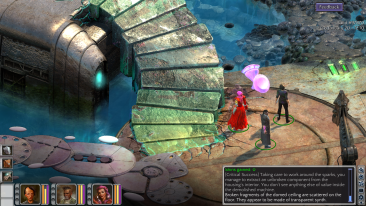
One of the best things about Planescape was its pervasive sense of weirdness and wonder. It’s a place where you can talk to a letter in the divine alphabet and help an alley give birth. Fortunately, the Ninth World is just as strange as Sigil. There’s a cool moment early in the beta when you stumble upon a pair of whirling pink cones. If you touch them, you’re rewarded with a vision of an alien landscape. It’s not clear that this has anything to do with the game’s plot, but I love it because it shows just how weird the Ninth World can be.

Things only get stranger from there. You see a man being executed by being wrapped in his own words made flesh (did one of the designers hear John 1:14 in church one day and start daydreaming?). You encounter members of a cannibalistic order that can experience the memories of those they eat (they’re actually a reasonably friendly bunch). You find a fountain of squirming fish-like creatures that speak in dead languages. If the rest of the game is as weird as the beta, TTON will be just as memorable as its predecessor.

Aside from the glitc2016-02-20.pnghes and bugs, TTON appears to have a solid foundation. But I do have a few minor complaints. For example, at one point I died (like in Planescape, you’re immortal, and you simply respawn when you die), and I ended up in a totally different part of the city. There is no world map or fast-travel feature, so I had to spend a lot of time running around in order to find my way back to where I needed to be. At the time, I happened to be in the middle of a quest to save someone from execution, and I wasn’t sure if I had time to explore since one of my companions kept reminding me that the condemned man would soon be dead. Happily, inXile appears to have taken steps to fix this in the first beta patch. After dying post-patch, an NPC gave me directions to get me back on track. But his directions were connected with a specific quest, and I don’t know what would have happened if that quest hadn’t been active.

I also wonder if TTON wouldn’t benefit from a bit more combat. While Planescape was less combat-oriented than Baldur’s Gate or Icewind Dale, you could find opportunities to fight if that was your thing. In TTON, on the other hand, combat is rare indeed. During my first playthrough, I only fought a handful of times, and they were all set-piece fights (according to the TTON website, there will only be a dozen or so Crises throughout the entire game).  I realize that the designers really like the idea of hand-crafted Crises, but I kind of missed the trash mobs since they added a bit of variety to the gameplay. I’m not saying that TTON needs to be a hack-‘n-slashfest like Diablo III, but it could have something like the random fights with the Hive thugs that you’d encounter in Planescape. I probably shouldn’t hold my breath–the developers have made it clear that they want to keep dungeon crawls and trash mobs out of TTON.

So those are my thoughts on the TTON beta. It’s a solid game with a lot of promise, and I’m even more eager for its release than I was before. Unfortunately, there’s still no word on a release date, and judging from the rough state of the beta, it seems that our vigil may be far from over. But with any luck, we’ll have an excellent game at the end of it.

An oral history of Diablo II

US Gamer has published a rather interesting oral history of Diablo II. It’s a long read, but it’s definitely worth checking out.

For me, the most interesting bits were the ones that talked about story development. I assumed that the designers were more or less in control of the game’s story, but with Diablo I and II, the cinematics team played a huge role in shaping the game’s narrative, and they worked more or less independently of the designers. For example, it was the cinematics team that decided that the hero should shove the soulstone into their forehead at the end of the first game. Judging from what Erich Schaefer says in the oral history, the design team wasn’t entirely sold on the idea, but there was nothing they could do about it.[note]On a side note, my Mom absolutely hates the ending to Diablo I. Although she’s spent hundreds of hours playing the game, she’s never killed Diablo since she doesn’t want to jam the soulstone into her head.[/note]

Diablo III has gotten a lot of flak for its weak story, and a lot of fans act as if the Blizzard North guys were master storytellers.[note]Blizzard North was a subdivision of Blizzard formed when they purchased Condor Games. Blizzard North went on to create Diablo, Diablo II, and Diablo II: Lord of Destruction. Blizzard Irvine disbanded the team in 2005.[/note] But the oral history suggests that the parent company has always played a key role in shaping the Diablo story, for better or worse.

This approach to story development might seem rather careless, but they had a lot less to work with back then. Many plot elements that fans now take for granted (e.g., the love affair between Inarius[note]Although Inarius was first mentioned in the Diablo I manual, his role there differs greatly from his role in the present canon.[/note] and Lilith,  Zayl the Necromancer) didn’t enter the canon until after the release of LoD. Richard A. Knaak in particular played a huge role in fleshing out the world of Sanctuary with his Sin War trilogy, but that didn’t come out until 2006-7. Blizzard’s approach to lore is a lot more professional nowadays (they even have a ‘Senior Vice President, Story and Franchise Development’), though as Diablo III shows, this method has its own drawbacks.

Interview with the developers of Torment: Tides of Numenera

Many of you know that Planescape: Torment is one of my all-time favorite video games (you can read my paean to the game here). Naturally, I’m thrilled that InXile is working on a spiritual successor to Planescape called Torment: Tides of Numenera. I recently had a chance to talk to the developers to learn more about the game, and you can read my interview over at Urban Gaming Elite.