Two hints for those who are trying to guess the identity of the background painting:
(1) It’s not the work of Hieronymus Bosch.
(2) Satan and his minions would probably hate this painting.
Two hints for those who are trying to guess the identity of the background painting:
(1) It’s not the work of Hieronymus Bosch.
(2) Satan and his minions would probably hate this painting.
I’m not going to beat around the bush: Aliette de Bodard’s “Obsidian and Blood” series is awesome, and you should read it.
There are currently two books in the series: Servant of the Underworld and Harbinger of the Storm. Set in the Aztec Empire several decades before the Spanish conquest, the books are told from the perspective of Acatl, the High Priest of the Dead. In Servant, Acatl’s estranged brother is implicated in the disappearance of a priestess, and Acatl must prove his innocence. In Harbinger, the political maneuvering that follows the death of the Revered Speaker (i.e. the Emperor) almost brings about the end of the world.
For me, the best part of the series is its historical accuracy. De Bodard clearly did her research, and it shows. At the same time, she’s skillful enough to make the world of the Aztecs come alive without resorting to a bunch of awkward info-dumps. There’s a fine line between “well-researched” and “pedantic,” and de Bodard walks it with grace.
Since this is fiction, a certain number of historical liberties were inevitable. To her credit, de Bodard discusses them in the Afterword instead of just sweeping them under the rug. I particularly liked how she dealt with the issue of names. Most of her characters are upper-class Aztecs, and upper-class Aztecs tended to have names that would strike a modern reader as terribly unwieldy. Instead of just making stuff up, de Bodard uses the shorter names borne by less-exalted Aztecs. For deities, she usually alternates between the Aztec name and its English translation. All and all, she does an excellent job of finding the middle ground between accuracy and accessibility.
The third book in the series, Master of the House of Darts, will be released in October. I’m sure it’s going to be awesome. I’ll definitely be adding it to my Kindle the moment it becomes available.
De Bodard also has a nifty blog that’s worth a gander. In addition to fascinating reflections on the writing process, she also posts awesome-looking recipes. Someday, when I actually have a real kitchen, I might actually try them out.
When I logged on to Steam the other day, I came across an interesting little program called Universe Sandbox. After a bit of hemming and hawing, I decided to give in to my curiosity and purchase it.
I hesitate to call it a ‘game’ since it’s more of a simulation than anything else. Basically, the whole point of Universe Sandbox is to have fun mucking about on a cosmic scale. See what happens to our solar system if you make the sun 200 times larger! Bombard the Earth with asteroids and giant teapots! Tinker with the planets’ orbits and watch the hilarity that ensues! The whole thing is entirely open-ended, though you can try to win various achievements through Steam.
If you grow tired of molesting our own solar system, you can make your own from scratch. Many of my attempts ended in carnage since my planets have a nasty habit of getting sucked into the stars that are supposed to anchor them (then again, maybe I shouldn’t be using Mu Cephei as the focal point of my solar system!). Eventually, after a lot of trial and error, I managed to figure out the sweet spot that ensures a stable orbit.
Perhaps the greatest thing about Universe Sandbox is that it’s a scientifically accurate toy, so your inner nerd will have a field day with it. If you’re not careful, you might actually find yourself learning something. It’s also a bargain at $9.99 if you get it through Steam.

I was rudely awakened this morning by the fire alarm. As I waited outside for the all clear to return to my cozy bed, I decided to download a sample of Wilbur Smith’s Warlock on my iPhone. Warlock is a fantasy novel set in ancient Egypt and I had been meaning to check it out for some time, but I never managed to get around to it until now.
By the end of the first page, it became apparent that artistic license was going to be the order of the day. I had hoped that Warlock would be a work of historical fantasy on par with Susanna Clarke’s Jonathan Strange & Mr. Norrell, but Smith took so many liberties with the past that it had a negative impact on my ability to enjoy the story.
Now I get the fact that this is a novel and not a history textbook. I also understand that artistic license is often necessary. But if you’re going to set your work in a real-world society, I think you have to adhere to a certain basic standard of authenticity. Populating your version of ancient Egypt with people named “Lostris” and “Memnon” is like writing a story about feudal Japan with characters named “Tiffany” and “Bartholomew.” If you’re going to fudge that many details, why not just go all the way and set your story in a wholly fictional world of your own creation?
Let me make one thing clear, though: I’m not saying that Warlock is a bad book because it lacks authenticity. It’s just not the sort of book I want to read. I think I’ll download something by C. J. Sansom instead…
Anglophile that I am, I joined 2 billion other people in watching the wedding of Prince William (now the Duke of Cambridge) and Catherine Middleton last Friday. It was, of course, a splendid affair that showed British pomp and circumstance at its best. The service was wonderful and a number of the hymns chosen by the royal couple were favorites of mine (in particular “Guide me thou, O Great Redeemer” and “I Was Glad”). I also have to give them a lot of credit for using the Series One marriage rite from Common Worship rather than the abysmal modern language rite with its cringeworthy talk of “the delight and tenderness of sexual union.”
Last Friday’s wedding demonstrated that the Monarchy can adapt to changing circumstances while still remaining grounded in history. Happily, it looks like ‘The Firm’ has learned the painful lessons of Diana’s unhappy tenure as Princess of Wales. Kate enters royal life much better prepared than Diana was and I think she will find the experience much less of an ordeal. And, unlike Charles and Diana, it was clear that William and Kate were very much in love. Their relaxed, easy demeanor stood in stark contrast to the stiff formality of William’s parents on their wedding day. Hopefully, this is a portent of a long and happy marriage and, come 2071, we’ll be celebrating their diamond anniversary. 🙂
This is cool:
http://www.unreportedheritagenews.com/2011/03/ancient-egyptians-made-arduous-trek-to.html
I have to admire someone who could leave the relative comfort of the Nile Valley and go off trekking through the desert. That takes a lot more guts than I have!
The idea of a correlation between the geography of Chad and the geography of the Underworld as described in the Amduat is intriguing. I’ve often thought that the distances mentioned were peculiarly specific and this could well explain that.
I visited my mom over Easter and, while I was there, I had the chance to look through some of my old books. One of the titles I came across was Tales of Ancient Egypt by Roger Lancelyn Green. A friend of C. S. Lewis and J. R. R. Tolkein, Green was a great popularizer of world mythology and folktales. Tales of Ancient Egypt was my first exposure to ancient Egyptian literature and his retelling of the Setna Khaemwaset stories captivated me. The sense of wonder that that little volume evoked has remained with me through the years and I owe Green an enormous debt of gratitude since his work set me on the path that would eventually lead me to Evil in Thebes.
Since I first read Tales of Ancient Egypt, I’ve read more Egyptian literature than any sane person should. I can now see how Green took liberties with his source material. Sometimes he bowdlerized, sometimes he simplified. Every once and a while, he embellished for dramatic effect. But because he was aiming to capture the spirit of his source material rather than the precise details, his renderings are often much more pleasing to the casual reader than the scholarly treatments found in Lichtheim or Simpson.
So if you’re looking for an accessible introduction to the world of Egyptian literature but don’t want to get bogged down in a sea of philological footnotes and opaque scholarly commentary (though I can’t imagine why anyone wouldn’t enjoy those things!), I highly recommend Green’s book.
Given the omnipresence of magic in ancient Egyptian society, it should come as little surprise that feats of magic are commonplace in Egyptian literature. Their stories are filled with wise lector priests who can reattach severed heads, part the Nile, or send animated wax figures into Nubia to beat up a local chieftain. But there is one person in Egyptian literature who never seems to work magic: the pharaoh. In fact, in a number of stories the king is actually rescued from death or humiliation by the skills of a crafty lector priest. This strikes me as odd.
Many of you have probably heard that Egyptian pharaohs were considered living gods. But while Egyptian texts are quite clear that the king becomes fully divine after death, the nature of his divinity while alive is much harder to pin down. The waters are muddied even further by the fact that kings such as Amenhotep III and Ramesses II seem to have been deified within their own lifetime and are in fact depicted making offerings to themselves.
Even if the Egyptians believed that their kings’ earthly divinity was strictly limited, that still doesn’t explain why he’s depicted as magically powerless in literature. Lector priests aren’t in any way divine, yet they’re capable of working great feats of magic so it’s hard to see why the king couldn’t do so as well, even if his divinity doesn’t really manifest itself until after he’s dead.
It could be that this is all an accident of preservation. After all, the existing corpus of Egyptian literature is doubtlessly just the tiniest fraction of what was originally produced. Unfortunately, this fragmentation also makes it difficult for us to draw meaningful conclusions. *Sigh* On the plus side, it does mean that, as a writer, I have a lot of leeway when it comes to making up my own explanation. 😀
I was reading a review today of Toby Wilkinson’s new book The Rise and Fall of Ancient Egypt where the reviewer mentioned “the failure of Egyptian writers to indulge in the kind of salacious detail that the Greeks and the Romans so relished.” While it is undoubtedly true that we have yet to find an Egyptian Suetonius or Tacitus, we can’t say that that such a person never existed.
Unfortunately, the written source material for ancient Egypt is fragmentary at best and the best preserved texts are those carved on monuments. As a result, we tend to have a lot of bland, official pronouncements about the glories of the king. But that doesn’t mean that more irreverent works didn’t exist; it just means that they’re less likely to have survived since they would’ve been written on papyrus.
We already have some tantalizing hints of scurrilous stories. Papyrus Westcar makes Khufu look like a jerk, while the tale of Pepy and General Sasenet suggests that the two of them were lovers. Demotic literature is even more irreverent: Thutmose III has his rear end whipped by magical figures sent from Nubia and Amasis is portrayed as a drunk. The tradition of writing down scandalous things about one’s superiors is probably as old as writing itself and I don’t think we should assume that the Egyptians were any more reticent about these things than anybody else.
As for Wilkinson’s book, I look forward to reading it, if only because I’m curious to see how he backs up some of his assertions. In particular, I wonder how he supports his claim that there was “close surveillance” of the populace in pharaonic Egypt. He’s a good scholar, so I’m sure it’ll be an interesting read.
I came across this picture of a statue of Amenope and his wife Hathor this evening.
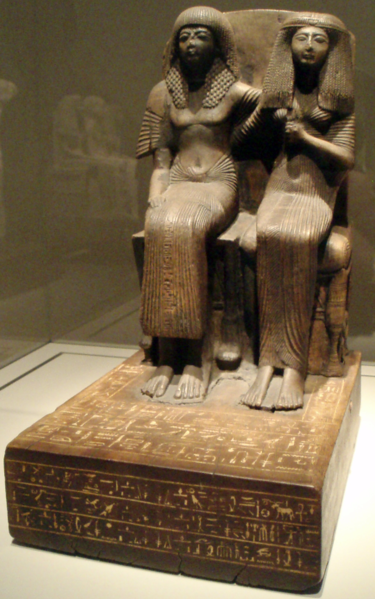 It’s a fairly typical New Kingdom statue of an aristocratic couple, but it made me think about the limits of the archaeological record.
As I looked at them sitting next to each other in a polite display of conjugal affection, I found myself starting to wonder what Amenope and his wife were like in real life. Was he a bore? Was she a nag? Did they comfort each other through life’s innumerable storms, or did they quietly grow apart? Were they happy with their lives, or did they want something more?
Egyptology has taught us a great many things about the ancient Egyptians. But, alas, some things will always remain lost in the past.
 Codex Lochianus